On August 12, 2026, the Karnataka Health Department announced it is drafting regulations to govern tattooing across the state. Commissioner K. Srinivas of the Food Safety and Drug Administration Department confirmed that an expert committee has been formed, a report analyzing available studies has been submitted, and a formal request has been sent to the Central government for nationwide rules. The rationale is engineering-straightforward: tattoo inks contain metals and chemicals that can enter the bloodstream during the procedure, and unregulated studios create a transmission pathway for hepatitis B, hepatitis C, and other blood-borne pathogens.
The Announcement in Engineering Terms
The Karnataka Health Department's position rests on two distinct failure modes that any materials engineer would recognize. The first is chemical: tattoo inks are not inert colorants. They contain pigments, heavy metals, preservatives, and carrier solvents. When injected into the dermis, a fraction of these compounds does not stay in the skin. The department's concern is systemic accumulation, where soluble components and nanoparticles migrate into the bloodstream and lymphatic system over time. This is not speculative; peer-reviewed work has documented pigment particles in regional lymph nodes and elevated metal concentrations in tissue after tattoo procedures.
The second failure mode is biological: an unsterile or improperly sterilized needle set is a direct inoculation vector. Hepatitis B survives on surfaces for extended periods, hepatitis C persists in dried blood, and both transmit efficiently through contaminated equipment. Without mandated sterilization protocols, a single careless studio can become a regional transmission node. The proposed framework targets both vectors: ink composition and studio practice.
What the Proposed Rules Cover
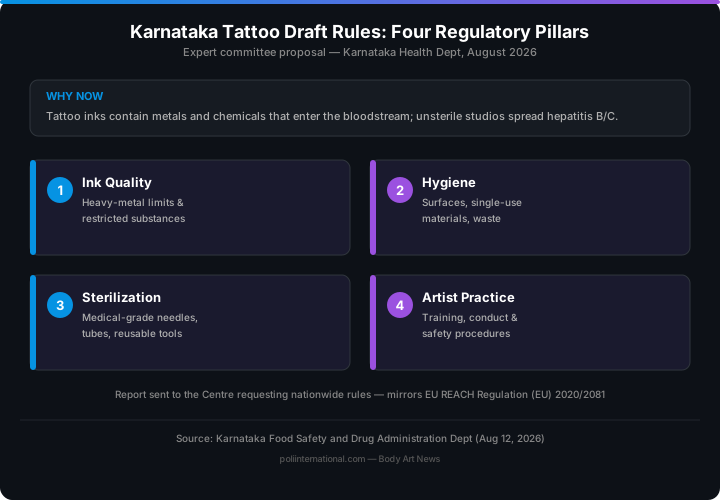
The expert committee's mandate spans four pillars, per the commissioner's announcement and the report sent to the Centre:
1. Ink quality and composition. Chemical and metal content in pigments, with the obvious implication that heavy-metal limits and restricted substance lists are coming. This mirrors the EU REACH restriction under Regulation (EU) 2020/2081, which bans specific pigments and hazardous substances in tattoo inks and permanent makeup across member states.
2. Hygiene standards. Mandatory cleanliness protocols for studios, covering surfaces, single-use materials, and waste handling.
3. Sterilization of equipment. Medical-grade sterilization requirements for needles, tubes, and reusable tools, with verification and documentation.
4. Artist practices. Professional conduct rules, training expectations, and safety procedures for practitioners.
The scope is notable for what it includes: it treats tattooing as a public health intervention point, not a lifestyle service. That framing, if adopted nationally, would align India with the stricter end of global practice.
The Regulatory Void in India
The critical context is what currently does not exist. India has no national legislation governing tattoo ink composition, studio licensing, or sterilization standards. Regulation is fragmented across state health departments, municipal licensing, and general consumer protection law. A tattoo studio in Bengaluru can operate under the same food-safety inspection regime as a restaurant, which is precisely the situation flagged when Karnataka's health department added tattoo studios to its inspection radar alongside food businesses and imported chocolates.
The Karnataka move matters beyond the state's borders because of the mechanism chosen. Instead of waiting for the Centre, the state has drafted its own framework and submitted a report requesting national adoption. This is the same pattern that preceded other public health standardization in India: state-level pilot regulation, followed by Union-level harmonization. If the Centre acts, the practical effect is a national compliance baseline for ink importers, studios, and training programs.
What This Means for the Industry
For studios, the immediate implication is preparation, not panic. The department has announced intent; specific rules, limits, and compliance deadlines will follow committee work. Studios in Karnataka should audit their ink supply chains now: request composition data sheets, verify pigment lists against known restricted substances, and document lot numbers. They should also standardize sterilization practices against the medical-grade baseline, including biological indicators on autoclave loads, before mandates arrive.
For ink manufacturers and distributors, the exposure is sharper. A composition-based rule means restricted substance lists, heavy-metal caps, and labeling requirements. The EU experience is the template: after REACH restricted certain pigments and introduced mandatory labeling, manufacturers reformulated products and withdrew non-compliant lines. Indian distributors should expect the same pressure, amplified by the size of the domestic market.
For artists, the regulatory signal is professionalization. Mandatory sterilization protocols, hygiene standards, and practice rules raise the barrier to entry and separate compliant professionals from the unregulated segment. In jurisdictions that have adopted such rules, the professional segment ultimately benefits because enforcement removes the price-undercutting that comes from skipped sterilization.
The International Precedent and What Comes Next
The Karnataka framework, if enacted, joins a well-established global pattern. The EU banned specific hazardous substances in tattoo inks under REACH in 2020 and implemented mandatory labeling in 2022. The FDA regulates tattoo pigments as color additives in the US, though without a comprehensive ink-specific composition rule. Australia and New Zealand enforce hygiene-based codes for skin penetration businesses. India, with its scale, would become the largest market with an explicit composition-and-hygiene framework.
The timeline from here depends on the committee's work and the Central government's response. The commissioner indicated the department has already analyzed available studies and submitted its report. The industry should monitor three signals: publication of the expert committee's recommendations, any draft rules issued for public comment, and the Central government's decision on nationwide adoption. Each is a trigger point for compliance work across the supply chain.
In the meantime, the engineering logic is settled. Ink chemistry and sterilization practice are the two controllable variables in tattoo safety. Karnataka is moving to regulate both. Studios that treat those variables as already governed will be ahead of the compliance curve when the rules land.
FAQ
When will the Karnataka tattoo regulations take effect?
The department has announced its intent and formed an expert committee, but specific rules and compliance deadlines have not yet been published. The committee must study ink composition, safety standards, and artist practices before draft rules are issued. Industry should expect committee recommendations followed by draft rules for public comment.
Does India currently have laws regulating tattoo ink?
No. There is no national legislation in India governing tattoo ink composition, studio licensing, or sterilization standards. This regulatory void is the core justification for Karnataka's action, and the state has formally requested the Central government to consider nationwide regulations.
Will these rules affect tattoo artists outside Karnataka?
Potentially yes. Karnataka has submitted a report to the Central government requesting nationwide regulation, and the department's commissioner has stated that regulations should be brought in based on the analysis. If the Centre adopts a national framework, studios across India would face the same compliance baseline.
What chemicals and metals are the concern in tattoo inks?
The department cited inks containing chemicals and metals that can enter the bloodstream during the procedure. Internationally restricted substances include specific azo pigments, heavy metals such as cadmium and lead, and hazardous solvents. The EU REACH restriction (Regulation (EU) 2020/2081) provides the current reference list of banned pigments and substances.
What should a Karnataka studio do right now?
Audit ink supply chains and request composition data sheets, document lot numbers, and verify pigments against restricted substance lists. Standardize sterilization practice to the medical-grade baseline, including biological indicators on autoclave loads. Prepare hygiene and waste-handling documentation before the formal rules arrive.