On August 6, 2026, the Kerala Health Department issued a public caution over unsafe tattooing. The warning, reported by The Hindu, flags the health risks that follow from inadequate sterilization and non-compliant practices in body art. This is not a niche concern for one Indian state: it is the same structural pattern that produces health warnings in Ontario, in Luxembourg, and everywhere else where body art grew faster than regulation. The engineering question is identical everywhere, and the answer is not a ban. It is sterilization discipline, material traceability, and a licensing regime that treats a needle as a medical device, because that is exactly what it is.
What the Kerala Health Department Announced
The Kerala Health Department has publicly cautioned residents about unsafe tattooing, citing the infection risks that accompany poor sterilization practices. The Hindu reported the advisory on August 6, 2026, making it the first official state-level body art caution in the region for this news cycle.
The warning sits on a well-documented risk foundation. Bloodborne pathogens, hepatitis B, hepatitis C, and HIV, transmit through contaminated needles and shared equipment. Hepatitis B is the most environmentally hardy of the three and can survive on surfaces for days, which means a single lapse in decontamination can expose every client who follows. [NEEDS CONFIRMATION: the exact wording of the advisory, the issuing official, and any infection counts or case numbers cited in the original statement]
The Technical Risk: What Unsafe Tattooing Actually Means
From an engineering standpoint, a tattoo machine is a delivery system for pigment into the dermis, and every component that touches the client is a potential vector. The failure modes are specific and preventable.
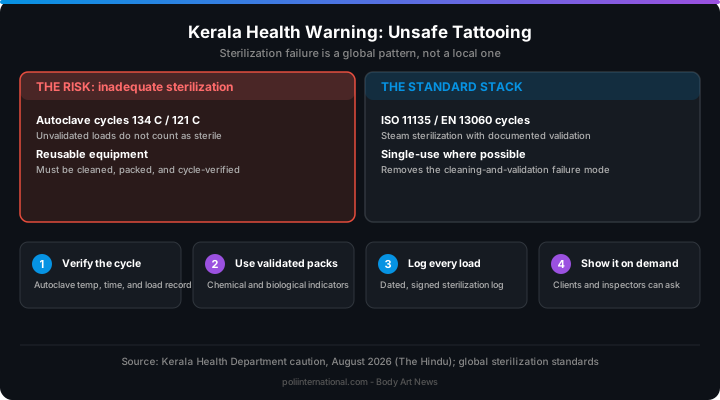
The first is needle reuse or improper sterilization. Needles must be single-use, opened from sterile packaging in front of the client, and disposed of into a sharps container immediately. Reusable equipment, if used at all, requires a validated autoclave cycle, not a boil, not an ultraviolet wand, not a chemical soak. EN 13060 governs small steam sterilizers and defines the temperature, pressure, and cycle validation requirements that make sterilization verifiable rather than assumed.
The second failure mode is cross-contamination in the workspace: ink bottles dipped into by multiple needles, pigment caps reused, work surfaces without barrier film, and artist hands that have not been washed between clients. Each of these is a direct line to the same bloodborne pathogens.
The third is material quality. Inks and jewelry that fail to meet composition standards can introduce heavy metals, sensitizers, and microbial contaminants directly into the dermis. The European Union answered this with REACH Annex XVII entry 75, which restricts hazardous substances in tattoo inks and permanent make-up and has been in force since January 2022. India does not yet have an equivalent, which makes ink sourcing a buyer-beware exercise.
Why This Pattern Repeats: The Regulatory Gap
Kerala's caution is the latest entry in a pattern that repeats across jurisdictions: a public health warning issued because body art regulation is fragmented. In India, there is no centralized licensing regime for tattoo artists. Oversight is distributed across state health departments, municipal bodies, and consumer protection frameworks, which means enforcement is reactive rather than preventive.
The same gap produced the Chatham-Kent warning in Ontario in July 2026, where an unlicensed provider with insufficient disinfection practices triggered a client-contact campaign for bloodborne pathogen testing. It produced the Luxembourg market surveillance report that identified non-compliant tattoo inks. In every case, the warning was not the failure. The failure was a system that allowed unlicensed or under-equipped operators to reach clients in the first place.
The Global Standard Stack
Professional studios already have the reference architecture. It is not mysterious, and it is not proprietary.
The World Health Organization's infection prevention guidance for body art settings anchors the process layer: hand hygiene, sterile equipment, single-use policy, and sharps disposal. Council of Europe Resolution ResAP(2008)1 sets requirements and criteria for the safety of tattoos and permanent make-up, covering hygiene, inks, and aftercare. EN 13060 defines autoclave performance for small steam sterilizers. ISO 11135 covers ethylene oxide sterilization for materials that cannot tolerate steam. REACH Annex XVII entry 75 restricts ink chemistry. A studio that assembles these standards is audit-ready in any jurisdiction, including one with no local regulation to point to.
What Professional Studios Should Do Now
A public caution in any jurisdiction is a leading indicator. The industry response should be the same whether the warning comes from Kerala, Ontario, or Luxembourg.
Audit the sterilization chain. Confirm that every needle is single-use, that any reusable equipment is processed through a validated autoclave with spore-test documentation, and that staff can explain the cycle parameters on demand. Move to single-use pigment caps and never dip a needle into a shared bottle. Demand composition data from ink and jewelry suppliers, and keep batch records for every product that touches skin. Adopt the global standard stack voluntarily, before a health department forces the question. Certification costs less than a shutdown order, and it converts a regulatory warning into a competitive advantage.
The lesson of Kerala is the lesson of every health warning before it: the industry that polices its own sterilization does not get policed by the state. [NEEDS CONFIRMATION: any India-specific enforcement actions or license requirements in force at the time of publication]
Hepatitis B is the most environmentally resilient bloodborne pathogen, remaining infectious on dried surfaces at room temperature for at least seven days, and up to 30 days in some studies. This means a single inadequate sterilization lapse in a studio can expose every subsequent client to the virus, making single-use needles and validated autoclave cycles—not chemical soaks—the only acceptable engineering control. Any reusable tattooing equipment must be processed in a steam sterilizer that complies with EN 13060, the European standard for small steam sterilizers, which mandates a minimum exposure of 3 minutes at 134°C (273°F) at 2.1 bar pressure, or 15 minutes at 121°C (250°F). The standard also requires cycle validation and documented physical or chemical indicators for every load—without that verification, sterilization is merely assumed, not proven. No—India currently has no equivalent to the European Union's REACH Annex XVII entry 75, which has restricted hazardous substances in tattoo inks and permanent make-up since January 2022, capping, for example, polycyclic aromatic hydrocarbons at 0.5 µg/g and lead at 2 mg/kg. This regulatory gap makes ink sourcing a buyer-beware exercise in Kerala and across India, placing the burden of traceability and composition verification squarely on the artist. It refers to the transfer of bloodborne pathogens between clients via shared non-needle vectors: dipping a needle into a multi-use ink bottle, reusing pigment caps between clients, failing to replace barrier film on work surfaces, or skipping hand hygiene between procedures. Each of these is a documented transmission route for hepatitis C and HIV, and eliminates them requires single-use ink caps, individual pigment portions, and disposable surface barriers changed between every client. The July 2026 warning was issued because an unlicensed provider with insufficient disinfection practices potentially exposed clients to bloodborne pathogens, triggering a formal contact-tracing campaign recommending hepatitis B, hepatitis C, and HIV testing for all affected individuals. The incident mirrors the Kerala advisory structurally: enforcement was reactive rather than preventive, and the root failure was a licensing gap that allowed an under-equipped operator to reach clients before any inspection occurred.FAQ
How long can hepatitis B survive on contaminated tattooing equipment?
What sterilization standard must a tattoo autoclave meet?
Are tattoo inks regulated for heavy metal content in India?
What exactly does "cross-contamination in the workspace" mean in a tattoo studio?
Why did the Chatham-Kent, Ontario warning issue a client-contact campaign for blood testing?