
How India’s New Tattoo Rules Expose the Real Weak Links in Ink, Hygiene, and Documentation
Key Takeaways:
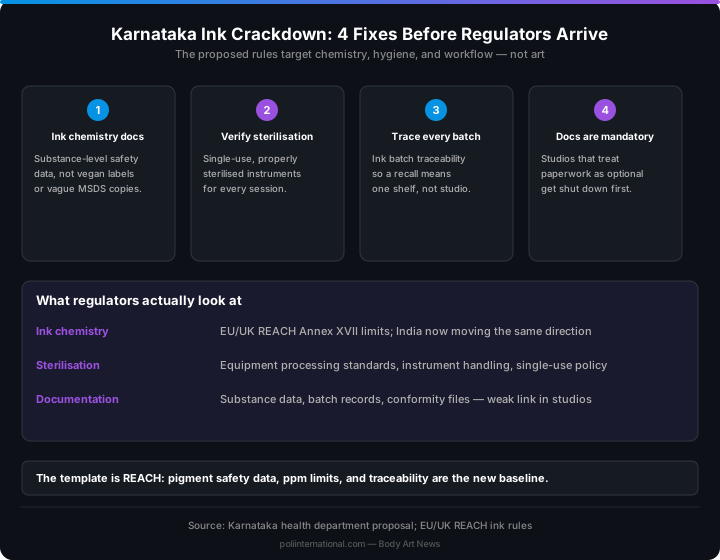
» Karnataka’s proposed rules target ink chemistry, sterilisation, and studio workflow, not “art,” but everything around it.
» Inks will need substance-level safety data, not just “vegan” labels or vague MSDS copies.
» Single-use, properly sterilised instruments and traceable ink batches are becoming non‑negotiable.
» Studios that treat documentation as optional will be first in line for shutdowns, not reform.
» The EU and UK REACH ink rules are the template; India is now clearly moving in the same direction.
---
1. Why Karnataka’s Ink Rules Matter Beyond India
Karnataka’s health department has kicked off a regulatory move to tighten control over tattoo ink safety, sterilisation, and studio hygiene in response to growing concern about infections and chemical exposure from tattoo pigments. The regional report explicitly calls out potential harmful chemicals or metals entering the bloodstream, and proposes an expert committee to set rules for ink composition, equipment processing, and procedural standards in the state’s studios, with a clear link to national-level regulation via the Centre’s involvement.Karnataka plans new rules for tattooing over health risks
If this sounds familiar, it’s because Europe already went there. Under EU REACH, Entry 75 created a pan‑EU ban on thousands of chemicals used in tattoo inks, including certain carcinogens, mutagens, reproductive toxins (CMR substances), problematic azo pigment breakdown products, and some solvents like isopropanol in specific formulations.Europe's tattoo artists fear for future after EU ink ban Tattooists across Europe complained that coloured ink supplies were gutted overnight, yet the logic behind the restriction was brutally simple: if you inject a substance into the skin, regulators will treat it closer to a medical exposure than to face paint. That same mindset is now showing up in Karnataka’s language about inks entering the bloodstream, and it will not stop at one Indian state.
The UK has already taken this fork independently. The UK government’s December 2025 decision made UK REACH restrictions on tattoo inks and permanent makeup legally binding under its retained REACH framework, explicitly targeting CMR substances, azo‑derived aromatic amines (with a 0.5 ppm limit per amine), and heavy metals like mercury, cadmium, lead, and chromium VI, while restricting nickel above 200 ppm.UK REACH Goes Independent: What the December 2025 Tattoo Ink Restrictions Really Mean Karnataka’s move reads like the early stage of the same process: start with “health risk” language and an expert committee, end with substance lists, ppm limits, and mandatory documentation. If you tattoo for money anywhere on Earth, this shift concerns you.
---
2. What Regulators Look At: Comparing EU/UK REACH and Emerging Indian Rules
Once regulators focus on tattoo inks, they almost always end up comparing a similar set of features: chemical hazard classes, heavy metal content, and documentation quality. To see where Karnataka is likely headed, it helps to look at how Europe has already drawn the lines.
| Feature | EU/UK REACH Model (EU Entry 75 / UK Annex 17) | Emerging Karnataka Focus |
|---|---|---|
| Target substances | Explicit lists of CMRs, specific azo pigments, aromatic amines, preservatives, solvents, and restricted colorants with defined thresholds | Broad concern about “harmful chemicals or metals entering the bloodstream,” likely to crystallise into targeted lists once the expert committee reports |
| Heavy metal limits | Mercury, cadmium, lead, chromium VI fully banned; nickel restricted (e.g. 200 ppm) in tattoo inks | No numeric limits published yet, but “harmful metals” language signals future ppm thresholds and banned species |
| Documentation requirements | Mandatory Certificate of Analysis (CoA) with substance‑level testing against REACH parameters; Safety Data Sheet (SDS) tailored to tattoo ink classification; manufacturer declarations of compliance | The report already emphasises “ink safety” review; practical enforcement will almost certainly hinge on labs reports and ink import/customs documentation |
| Scope of regulation | Tattoo inks and permanent makeup formulations explicitly defined, with phase‑in periods and enforcement dates | Tattooing practices, ink safety, equipment sterilisation and hygiene standards within Karnataka; national rules may follow once committee recommendations reach the Centre |
| Studio obligations | Use compliant inks, maintain traceability, follow infection‑control standards; non‑compliant inks become illegal products | Anticipated requirements for sterilisation, safe ink use, and potentially registration or inspection of studios, framed as health‑risk control rather than art regulation |
The important point for practitioners: none of this is about style, colour choice, or “artistic freedom” in itself. It’s about whether the pigment you push through a needle can be traced, quantified, and defended with hard data. That’s the same logic behind the way we engineered needle geometry and pigment delivery to minimise dermal trauma and accelerate macrophage clean‑up, because once you admit something is being driven into living tissue, you’re in biology, not fashion.How Needle Taper and Ink Delivery Shape Dermal Trauma and Recovery
---
3. The Technical Detail: PPM Limits, Viral Infections, and What Studios Need on Paper
Once committees start writing rules, they stop speaking in generalities and start speaking in numbers. Under EU and UK REACH, the central concepts are:
- CMR substances: Carcinogenic, mutagenic, or toxic to reproduction. Presence above tiny thresholds is banned outright in tattoo inks.
- Aromatic amines from azo pigments: The EU limit is 0.5 ppm per amine when pigments can release these compounds through metabolic or environmental breakdown.UK REACH Goes Independent: What the December 2025 Tattoo Ink Restrictions Really Mean
- Heavy metals: Mercury, cadmium, and lead are banned; chromium VI is banned; nickel is limited (e.g. 200 ppm). Above those values, inks are simply illegal to sell or use in those markets.
- Documentation: Studios need a third‑party CoA showing testing against these parameters, plus an SDS updated for the correct regulatory framework and a written manufacturer statement that the ink meets Annex 17 / Entry 75 requirements, not just “REACH compliant” in marketing copy.
Karnataka’s plan mentions forming an expert committee and scrutinising “ink safety, hygiene, equipment sterilisation and tattooing practices, amid concerns over infections and harmful chemicals or metals entering the bloodstream.” That is the same trajectory Europe followed: start with infection stories and toxic‑ink headlines, end with limits in ppm and banned lists.Karnataka plans new rules for tattooing over health risks
On the infection side, the science has been unambiguous for years. Reviews of tattoo‑associated viral infections show that viruses like HSV, HPV, molluscum contagiosum, and systemic pathogens such as hepatitis B, hepatitis C, and HIV can be transmitted through tattooing when contamination control fails, whether by re‑used needles, contaminated ink caps, or cross‑contamination during the procedure.Tattoo-Associated Viral Infections: A Review Another review focused on infections confined to tattooed skin notes that cases predominantly occur in young, otherwise healthy adults, reinforcing that you don’t need to be immunocompromised for a contaminated needle or ink load to cause serious trouble.Viral Infections Confined to Tattoos—A Narrative Review
That’s why regulators in places like South Korea’s soon‑to‑be‑implemented Tattooist Act have gone as far as mandating single‑use needles, cartridges, and pigment cups, with strict separation of procedure and cleaning areas and formal bans on uncertified imported inks bought via “direct purchase.”Government prepares standard guidelines ahead of Tattooist Act enforcement When Karnataka talks about ink safety, equipment sterilisation, and infection risk, it is tugging at the same thread. Once the committee reports, you should expect language like:
- “Inks must not contain listed substances above 0.5 ppm”
- “Inks must be tested for heavy metals to specified limits”
- “Studios must maintain traceability of ink batches and retain CoAs for inspection”
- “Needles, cartridges, and cups must be sterilised single‑use and disposed of immediately after use”
For studios, the practical implication is brutal but simple: if your supply chain can’t produce a test report, the ink will eventually become unuseable. The same logic applied when we created BioFlex® body jewelry from a PP‑R random copolymer, certified as passing the ISO 10993 biological tests, on USP Class VI resin; the material had to sit in healing tissue, so we specified the resin like a medical material, not a fashion accessory.Why BioFlex® Is Not “Temporary Plastic”: The Real Chemistry Behind Flexible Body Jewelry Tattoo inks are now entering that same regulatory universe.
---
4. Patrick’s Note: The Question He Asks and Answers
Why do regulators always arrive late to the party, and then act like everyone’s been reckless from day one?
What the data doesn’t tell you is how many studios quietly fixed this years ago and how many are still operating on trust‑me inks with no analytical data behind them. I’ve lost count of how many times I’ve been sent “lab reports” that turn out to be generic MSDS sheets or a pigment supplier’s brochure, when what’s actually needed is substance‑level testing against REACH‑style parameters, CMR screens, aromatic amines, heavy metals, and preservative content.
From a supply chain perspective, the studios that will survive regulations like Karnataka’s are the ones that already treat ink as a medical exposure with paperwork rather than a coloured liquid in a pretty bottle. That means requiring real CoAs, understanding what 0.5 ppm of an aromatic amine implies, and aligning your needle and pigment choice with what we know about dermal trauma, macrophage behaviour, and pigment stability instead of just asking whether a colour looks good in the cap.How Needle Taper and Ink Delivery Shape Dermal Trauma and Recovery The committees aren’t inventing a new universe; they’re catching up to the engineers and clinicians who already have the numbers. If your ink shelf can’t survive that conversation, it’s not the committee that’s the problem.
---
5. FAQ: Technical Q&A
Q: What minimum documentation should I demand from my ink supplier to stay ahead of new rules like Karnataka’s?
You need a third‑party Certificate of Analysis with substance‑level testing for CMRs, aromatic amines from azo pigments, and heavy metals, plus an ink‑specific Safety Data Sheet aligned with the relevant REACH framework. You should also insist on a written statement that the ink meets the current regulatory annex or restriction (e.g. UK REACH Annex 17 or EU Entry 75), because that’s exactly what inspectors will look for when new national rules land.
Q: Are “vegan” or “organic” labels on inks relevant to chemical safety in a regulatory sense?
No. “Vegan” only tells you there are no animal‑derived ingredients, and “organic” is usually marketing language with no binding definition for injected pigments. Regulators care about CMR profiles, aromatic amine release, preservative toxicity, and heavy metal content, not lifestyle branding. An ink can be vegan and still fail hard on nickel or aromatic amine limits once proper testing is done.
Q: How should I adapt studio workflow if my region starts copying South Korea or Karnataka‑style rules?
You should assume single‑use needles, cartridges, and pigment cups will become mandatory, with strict separation between procedure areas and cleaning zones. Implement high‑level disinfection for reusable grips and holders, maintain batch traceability for every ink used, and log aftercare advice (e.g. water avoidance and blood donation moratoria) in a way that can be shown during inspection. If you treat your space like a small outpatient clinic rather than an art room, you’ll be ready when the official guidelines arrive.
---
Conclusion: Get Your Ink Shelf Future‑Proof
Regulation is now moving from Europe and the UK into India and other markets, and Karnataka’s proposed rules are a clear signal that ink chemistry, sterilisation standards, and documentation are about to be non‑negotiable in more parts of the world. The studios that adapt will be the ones that stop asking “is this colour popular?” and start asking “does this bottle come with a CoA that proves it meets CMR and heavy‑metal limits in ppm?” before a needle ever touches skin.
If you’re serious about future‑proofing your studio, treat Tattoo REACH‑style rules the way we treat biocompatibility in engineered materials: start from the science, build your workflow around documented safety, and let the art sit on top of a foundation regulators can’t knock down.UK REACH Goes Independent: What the December 2025 Tattoo Ink Restrictions Really Mean
---


