
Key Takeaways:
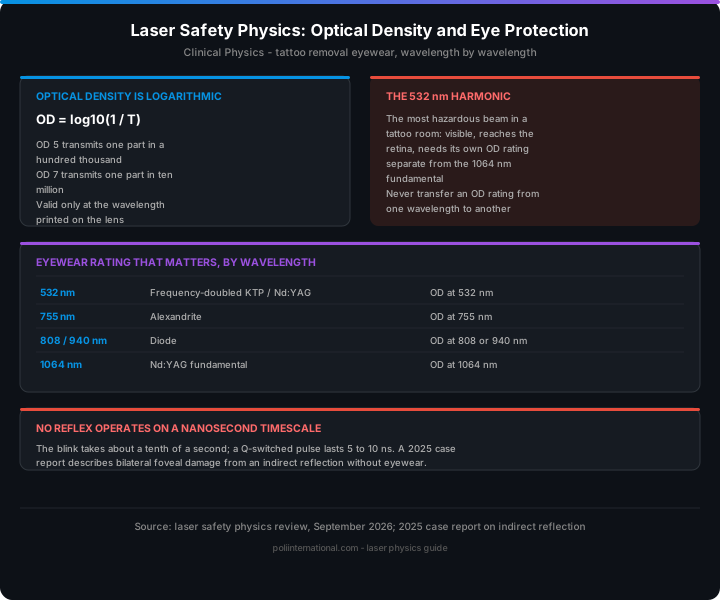
» Optical density is logarithmic and wavelength-specific. OD 5 means one part in 100,000 transmitted, but only at the wavelength printed on the lens.
» The 532 nm harmonic is the most hazardous beam in a tattoo room. It is visible, it reaches the retina, and it needs its own OD rating separate from the 1064 nm fundamental.
» No reflex operates on a nanosecond timescale. The blink takes about a tenth of a second; a Q-switched pulse lasts 5 to 10 ns.
» Indirect exposure is a documented injury mechanism. A 2025 case report describes bilateral foveal damage in a nurse removing a tattoo with a picosecond laser without eyewear.
» Eyewear is the last control. Beam path, surface finish, and a marked hazard zone come first.
Optical Density: The One Number That Matters
Optical density (OD) is the specification that describes protection, and it is logarithmic. The relationship is OD = log10(1 / T), where T is the fraction of light the filter transmits at a stated wavelength. OD 5 transmits one part in a hundred thousand. OD 7 transmits one part in ten million. Filters stack additively in the simple case: two OD 4 lenses behave like a single OD 8 filter.
The physical basis is the Beer-Lambert law, in which transmitted intensity falls exponentially with absorber concentration and path length. That is why the protection figure is logarithmic, why small OD differences mean large energy differences, and why the phrase attached to every honest rating matters more than the number: at a stated wavelength.
Absorption is resonant: a dye, doped glass, or dielectric coating attenuates strongly in the band it was engineered for and weakly outside it. Untinted polycarbonate, the base of most clear workshop spectacles, blocks impact and ultraviolet light but passes much of a near-infrared beam. Tinted fashion sunglasses reduce visible light for comfort, which is a different objective from attenuating a 1064 nm pulse. A dark lens can therefore offer measurably less protection than clear polycarbonate at the wavelength that matters, while feeling far safer to wear.
Why the Wavelength Decides Everything
Pigment lasers cluster at wavelengths chosen for pigment absorption on one side and skin transmission on the other: 532 nm from a frequency-doubled KTP crystal, 694 nm ruby, 755 nm alexandrite, 808 nm and 940 nm diode, and the 1064 nm Nd:YAG fundamental. Each sits in a different position in the eye's optical chain and needs a filter rated for that specific line.
The 532 nm beam deserves particular attention. It is visible, so the cornea and lens pass it and the macula focuses it onto a spot far smaller than the original beam. Melanin and haemoglobin absorb it strongly, which is why it clears red and orange pigment efficiently and why 532 nm injury is the classic accident in the laser literature. Many clinical systems emit 532 nm and 1064 nm from the same handpiece, so one filter has to be verified at two wavelengths at once.
The 1064 nm fundamental removes the eye's warning systems: it is invisible, so there is no aversion response and no cue that a beam has entered the room. Invisible near-infrared is the class where operators most often assume dark glasses are sufficient.
| Wavelength | Typical system | Absorbed first by | Eyewear rating that matters |
|---|---|---|---|
| 532 nm | Frequency-doubled KTP / Nd:YAG | Melanin and haemoglobin in the retina | OD at 532 nm, with visible transmission high enough to read the endpoint |
| 755 nm | Alexandrite | Melanin | OD at 755 nm |
| 808 / 940 nm | Diode | Melanin, water weakly | OD at 808 or 940 nm, not transferable from 1064 nm |
| 1064 nm | Nd:YAG fundamental | Water weakly, pigment particles | OD at 1064 nm; invisible beam, no blink response |
The Eye as a Five-Order-of-Magnitude Amplifier
A beam that is harmless against skin can still destroy the fovea, because the eye is an optical system with gain. A dark-adapted pupil collects light across roughly 7 mm of aperture and the cornea and lens converge it onto a retinal spot of 10 to 20 micrometres, raising irradiance at the retina by about five orders of magnitude. The retina also has no heat sink comparable to skin: a few millijoules in a thin, pigmented, poorly perfused layer can produce a permanent scotoma at the point of fixation.
Time makes the asymmetry worse. The blink reflex closes the eyelid in roughly 100 milliseconds. A Q-switched pulse lasts 5 to 10 nanoseconds and a picosecond pulse 300 to 900 picoseconds, so energy delivery happens about seven orders of magnitude faster than the body's fastest protective reflex. Blink protection is real for continuous visible beams and irrelevant for pulsed lasers.
Exposure limits follow from that arithmetic. The maximum permissible exposure (MPE) for a nanosecond pulse in the visible region sits below one microjoule per square centimetre, and at 1064 nm it is measured in a few microjoules per square centimetre. A Q-switched tattoo laser delivers roughly 1 to 4 joules per square centimetre to the skin, six to seven orders of magnitude above the limit. The nominal hazard zone is calculated from pulse energy, beam divergence, and worst-case surface reflectivity. A matte surface returning only 2 per cent of a 4 joule pulse still returns far more than the MPE, which is why the operator position is defined by geometry rather than optimism.
The Documented Injury: Indirect Reflection, Bilateral Damage
The most instructive recent case is a 2025 report of a 23-year-old nurse in a cosmetic surgery clinic performing picosecond KTP/Nd:YAG tattoo removal. The procedure became complicated, she did not use protective eyewear, and she experienced dazzle. Thirty minutes after starting, she had central scotomas in both eyes. Best-corrected acuity fell to 0.6 right and 0.3 left, with a lamellar defect and focal outer retinal detachment on the right and foveal haemorrhage on the left. The right eye developed a full-thickness macular hole that needed two vitrectomies, and a year later acuity had recovered only to 0.4 with a persistent outer retinal defect.
Two details matter more than the outcome. The exposure was indirect, arriving as a reflection rather than a direct beam path into the eye, and the damage was bilateral, the signature of diffuse or glancing reflection filling the room. Eyewear programmes are usually designed around the direct beam, treating reflections as the low-risk case. Metal instruments, glass, trays, and glossy cured pigment all produce specular returns that carry far more energy than a matte surface does.
Control the Room Before You Cover the Eyes
Eyewear sits at the bottom of the control hierarchy. Substitution comes first: fewer passes at higher fluence is generally safer than more passes at lower fluence, because total exposure scales with the number of pulses fired. Engineering controls come next, and they are what most body-art clinics skip: a defined and marked nominal hazard zone, a beam path terminating in a beam stop rather than a wall, matte surfaces inside the zone, door interlocks, and a handpiece holster so the laser is never left live and pointing horizontally. Administrative controls follow: a named laser safety officer, a written procedure, documented training, and credentialling for each wavelength. Only then does protective equipment enter the discussion.
Eyewear selection has four requirements that are easy to get wrong. The OD must be specified at the wavelength in use, with the manufacturer certificate on file rather than the lens colour trusted. The frame must close the peripheral gap, since side entry is a real path for glancing reflections. Visible transmission must be high enough to read the endpoint, because an overdark lens invites operators to remove eyewear mid-treatment. And the filter must be undamaged: crazing, solvent haze, and pitting degrade verified density.
Patient protection is a separate requirement and it is mandatory for periocular work. Eyeliner and eyebrow removal needs corneal shields or external eye shields rather than a request to close the eyes, because eyelids do not attenuate a picosecond pulse. The final hazard in the room is not optical: vaporised tissue and pigment generate a plume carrying viable particles, and local exhaust ventilation at the handpiece is the control for it.
Clinical Takeaways
1. Read the eyewear label as a specification, not a colour. Protection exists only at the wavelength printed beside the OD number.
2. Verify the OD for every wavelength the system fires, including the 532 nm harmonic, and keep the manufacturer certificate on file.
3. Treat reflections as a first-order hazard. Diffuse returns have caused bilateral foveal damage.
4. Engineer the room before buying equipment: beam stop, matte surfaces, marked hazard zone, and holster.
5. Do not rely on blink or aversion responses. Pulses are seven orders of magnitude faster than the reflex.
6. Shield the patient's eyes for periocular treatment and control smoke at the handpiece.
Further Reading
Optical density is a logarithmic measure of attenuation defined as OD = log10(1/T), where T is the fraction of light transmitted at a stated wavelength. OD 5 transmits one part in 100,000, while OD 7 transmits one part in ten million, meaning small numeric differences represent enormous energy differences. Critically, every OD rating is valid only at the wavelength printed on the lens, so a filter rated OD 7 at 1064 nm may offer almost no protection at 532 nm. The 532 nm beam is visible, so the cornea and lens transmit it and the macula focuses it onto a spot far smaller than the original beam, concentrating energy on the fovea. Melanin and haemoglobin absorb it strongly, which is why 532 nm injury is the classic accident described in the laser literature. Because many clinical systems emit both 532 nm and 1064 nm from the same handpiece, eyewear must be verified at both wavelengths simultaneously. No. The human blink reflex takes roughly a tenth of a second (about 100 milliseconds), while a Q-switched pulse lasts only 5 to 10 nanoseconds. That is a difference of roughly four orders of magnitude, so no aversion response, blink, or head-turn can occur within the pulse duration. This is why eye protection must be worn before the laser is armed, not relied upon as a reactive measure. Yes. A 2025 case report describes bilateral foveal damage in a nurse who was removing a tattoo with a picosecond laser without wearing eyewear, confirming that indirect or scattered exposure is a documented injury mechanism. The eye acts as a five-order-of-magnitude amplifier, so a beam that is harmless against skin can still destroy the fovea. This is why beam path control, matte surface finishes, and a marked hazard zone are primary controls, with eyewear as the last line of defense. No. Tinted fashion sunglasses reduce visible light for comfort, which is a different objective from attenuating a 1064 nm pulse, and untinted polycarbonate blocks impact and ultraviolet light but passes much of a near-infrared beam. A dark lens can offer measurably less protection than clear polycarbonate at the wavelength that matters while feeling far safer to wear. Proper laser eyewear uses dye, doped glass, or dielectric coatings engineered to attenuate a specific wavelength line, such as 532, 755, 808, 940, or 1064 nm.FAQ
What does optical density (OD) actually mean on laser safety glasses?
Why is 532 nm considered the most dangerous wavelength in a tattoo removal room?
Will my blink reflex protect me from a Q-switched laser pulse?
Can a tattoo laser injure someone who is not the patient?
Are dark sunglasses or tinted safety glasses adequate for tattoo laser protection?


