
Key Takeaways:
» Radiation dosimetry defines the energy deposited per unit area (fluence) and its temporal profile (pulse duration).
» Selective photothermolysis requires pulse durations shorter than the thermal relaxation time of tattoo pigments.
» For radiation‑related tattoos, a 20‑ns Q‑switched ruby laser at 4–6.5 J/cm² fluence achieved 91 % clearance with no adverse events.
» Eye protection is mandatory: reflected and scattered laser radiation can exceed the maximum permissible exposure (MPE) for the retina.
» Picosecond lasers allow lower fluence (1–2 J/cm²) while reducing thermal injury risk.
Radiation Dosimetry Fundamentals
Laser tattoo removal relies on selective photothermolysis: the laser wavelength must be strongly absorbed by the tattoo pigment, and the pulse duration must be shorter than the pigment’s thermal relaxation time (TRT) to confine heat to the target and avoid collateral damage. For most tattoo pigments, TRT ranges from 10 ns to 1 µs, necessitating nanosecond‑ or picosecond‑scale pulses.
The fluence (energy density, J/cm²) determines how much energy is delivered per pulse. Too low a fluence fragments pigment inefficiently, requiring more sessions; too high a fluence causes wholesale heating, leading to blistering, scarring, or dyspigmentation. Clinical guidelines recommend starting at the lower end of the recommended range and titrating upward based on the observed clinical endpoint (immediate whitening or slight blanching).
Evidence from Radiation‑Related Tattoos
A prospective interventional study of breast‑cancer survivors with radiation‑related tattoos treated with a 20‑ns Q‑switched ruby laser (694 nm) reported excellent outcomes [1]. Parameters were:
- Wavelength: 694 nm (ruby)
- Pulse duration: 20 ns
- Spot size: 4 mm
- Fluence: 4–6.5 J/cm² (adjusted to achieve slight blanching)
- Sessions: 1–5 (average 3.2)
Results showed 91 % of tattoos demonstrated significant improvement or complete resolution, with zero adverse events reported. All patients resumed normal activities immediately after each session. This study demonstrates that precise dosimetry—matching pulse duration to TRT and selecting an appropriate fluence—can achieve high efficacy while maintaining an excellent safety profile, even in a population with prior radiation exposure.
Practical Protocol Recommendations
Wavelength Selection
- 694 nm (ruby): High melanin absorption; excellent for dark tattoos and radiation‑related pigments. - 755 nm (alexandrite): Strong absorption for green and blue pigments; deeper penetration. - 1064 nm (Nd:YAG): Lower melanin absorption, safer for darker skin tones (Fitzpatrick IV–VI); effective for black and dark blue tattoos. - 532 nm (frequency‑doubled Nd:YAG): Targets red, orange, and yellow pigments; requires careful eye protection due to visibility.Spot Size and Pulse Duration
- Spot sizes of 3–6 mm balance energy density and treatment speed. - Pulse durations should be ≤ 20 ns for Q‑switched lasers; picosecond lasers (450–750 ps) further reduce thermal confinement time.Fluence Ranges
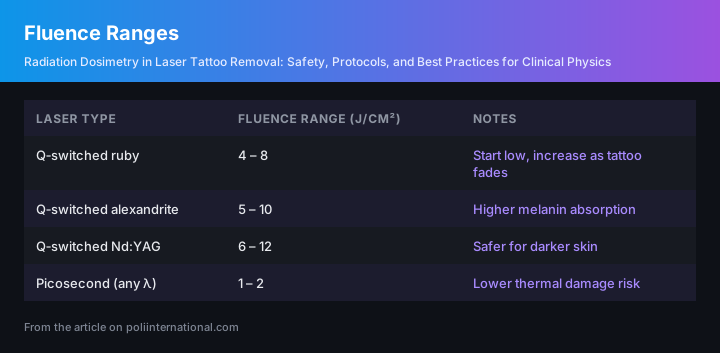
| Laser Type | Fluence Range (J/cm²) | Notes |
|---|---|---|
| Q‑switched ruby | 4 – 8 | Start low, increase as tattoo fades |
| Q‑switched alexandrite | 5 – 10 | Higher melanin absorption |
| Q‑switched Nd:YAG | 6 – 12 | Safer for darker skin |
| Picosecond (any λ) | 1 – 2 | Lower thermal damage risk |
Treatment Interval
Sessions are typically spaced 6–8 weeks apart to allow macrophage clearance of fragmented pigment and skin healing. Most patients require 6–10 sessions for satisfactory clearance, depending on tattoo size, pigment depth, and individual response.Adjunctive Measures
- Cooling: Contact cooling (e.g., Zimmer cryo‑unit) before, during, and after each pulse reduces epidermal injury. - Sun protection: Broad‑spectrum SPF 30+ sunscreen on treated areas prevents post‑inflammatory hyperpigmentation. - Patient counseling: Realistic expectations about session count and possible transient side effects (erythema, edema).Ocular Safety and Radiation Hazards
Laser radiation poses a significant ocular hazard. Reflections from specular surfaces or diffuse back‑scatter from the skin can deliver energy exceeding the maximum permissible exposure (MPE) for the retina, especially at wavelengths 694 nm, 755 nm, and 1064 nm [2].
Key precautions:
- Engineering controls: Beam stops, non‑reflective surfaces, and a marked nominal hazard zone (NHZ).
- Administrative controls: Training, standard operating procedures, and laser safety officer oversight.
- Personal protective equipment (PPE): Laser‑protective eyewear with an optical density (OD) rating specific to the laser wavelength. OD 5–7 at the operating wavelength is commonly sufficient to bring reflected exposure below MPE.
- Patient eyewear: For periocular treatment, corneal shields or opaque goggles are required; for other body sites, closed‑eye protocols with protective shields remain standard.
A documented case of bilateral foveal damage occurred when a nurse removed a tattoo with a picosecond laser without eyewear, underscoring that the human blink reflex (~100 ms) is far too slow to protect against nanosecond or picosecond pulses.
Advances in Dosimetry: Picosecond Lasers
Picosecond lasers ( pulse duration 450–750 ps ) deliver energy more closely matched to the TRT of tattoo pigments, enhancing photomechanical (shockwave) and photothermal effects while minimizing heat diffusion. This allows clinicians to use lower fluence (1–2 J/cm²) compared with nanosecond lasers, reducing the risk of blistering and scarring while maintaining or improving clearance rates [3].
Fluence titration remains essential: start at the lower end of the range and increase only if the clinical endpoint (whitening or slight blanching) is not achieved.
Conclusion
Accurate radiation dosimetry is the cornerstone of safe and effective laser tattoo removal. By selecting the appropriate wavelength, pulse duration, spot size, and fluence—and by implementing rigorous ocular safety measures—clinicians can achieve high clearance rates for radiation‑related tattoos while minimizing adverse outcomes. The evidence from recent clinical studies supports a protocol of 20‑ns Q‑switched ruby laser at 4–6.5 J/cm² fluence as a safe starting point, with picosecond lasers offering a lower‑fluence alternative for patients seeking reduced thermal injury risk.
Fluence ranges are laser- and pigment-dependent: Q-switched ruby typically uses 4–8 J/cm², Q-switched alexandrite 5–10 J/cm², and Q-switched Nd:YAG 6–12 J/cm². The evidence-based protocol for radiation-related tattoos used 4–6.5 J/cm² with a 20-ns Q-switched ruby laser, adjusted to achieve slight blanching, and reported 91% significant improvement or complete resolution with zero adverse events. Always start at the low end of the range and titrate upward based on the observed clinical endpoint. The pulse duration must be shorter than the tattoo pigment's thermal relaxation time (TRT), which typically ranges from 10 ns to 1 µs for most pigments. This is why nanosecond-scale pulses (≤20 ns for Q-switched lasers) are standard, and picosecond lasers (450–750 ps) provide even tighter thermal confinement. Shorter pulses confine heat to the pigment particle and reduce collateral epidermal damage. Most patients require 6–10 sessions for satisfactory clearance, depending on tattoo size, pigment depth, and individual response, with sessions spaced 6–8 weeks apart to allow macrophage clearance of fragmented pigment and skin healing. In the radiation-related tattoo study, patients needed 1–5 sessions (average 3.2) using a 20-ns Q-switched ruby laser at 4–6.5 J/cm². Smaller, superficial tattoos generally clear faster than large or deep pigmented ones. Picosecond lasers allow lower fluence—typically 1–2 J/cm² versus 4–12 J/cm² for Q-switched systems—while reducing thermal injury risk because their shorter pulse duration (450–750 ps) confines heat more tightly to the pigment. This lower thermal load may reduce blistering and dyspigmentation risk, though wavelength selection still must match the pigment. Both system types remain effective; the choice depends on pigment color, skin type, and clinical endpoint. Eye protection is mandatory for both patient and operator because reflected and scattered laser radiation can exceed the maximum permissible exposure (MPE) for the retina. Wavelength-specific eyewear must be matched to the laser in use—particularly for 532 nm frequency-doubled Nd:YAG, whose visible output demands careful filtering. Never rely on general-purpose sunglasses; only certified laser safety goggles rated for the specific wavelength and pulse duration are acceptable.FAQ
What fluence is used for Q-switched laser tattoo removal?
What pulse duration is needed for selective photothermolysis in tattoo removal?
How many laser sessions does it take to remove a tattoo?
Are picosecond lasers safer than Q-switched lasers for tattoo removal?
What eye protection is required during laser tattoo removal?


