The Tax Deduction Checklist Every Self-Employed Tattoo Artist and Piercer in the UK Needs
Key Takeaways:
» You pay tax on profit, not turnover, so every pound you legitimately deduct reduces your Income Tax and Class 4 National Insurance bill pound for pound.
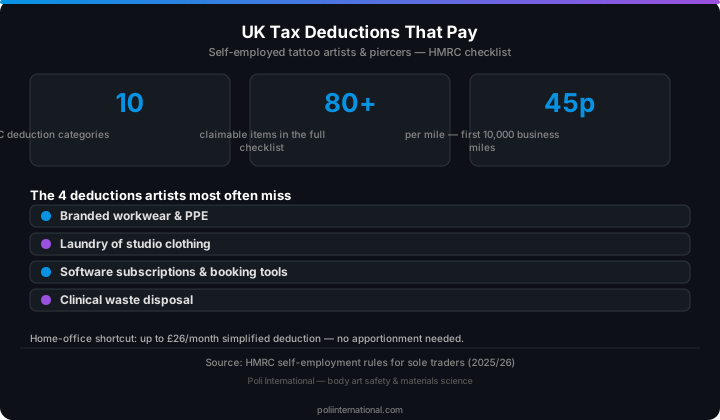
» The full checklist spans ten HMRC-compliant categories and more than eighty deductible items, from capital allowances on machines to bad debts written off.
» Branded workwear, laundry, software subscriptions and clinical waste disposal are the four deductions self-employed artists most often miss.
» Mileage at 45p per mile for the first 10,000 miles and the simplified home office deduction of up to £26 per month need no complex apportionment.
» When a claim is borderline, the professional move is to ask your accountant before filing, because an incorrectly claimed deduction is worse than a missed one.
1. Why profit, not turnover, is what the taxman sees
If you are self-employed in a tattoo or piercing studio, HMRC taxes you on your trading profit, not your gross turnover. Every eligible expense you record reduces that profit, and the reduction flows straight to your tax bill. The difference between claiming what you remember in January and claiming everything you are entitled to across the year is often hundreds or thousands of pounds. The checklist is built for year-round use: keep it in the studio, tick items as you spend, attach the receipts, and hand the completed log to your accountant in April.
Two structural points matter before any category detail. First, the deduction test applies to every item: is the expense incurred wholly and exclusively for the purposes of the business? If yes, it is claimable. If it has any significant personal use, only the business proportion is claimable. Second, records matter more than the claim itself. HMRC accepts reasonable estimates for minor items, but for equipment, travel and home use it expects invoices, receipts and a method you can explain. The studios that lose arguments with HMRC are almost never the ones that claimed too much; they are the ones that claimed without records.
2. The ten categories that cover almost every studio deduction
Equipment and tools (capital allowances). Tattoo machines, whether coil, rotary or pen style, are claimed through the Annual Investment Allowance (AIA), which for most sole traders covers the full cost in the year of purchase. Power supplies, autoclaves, ultrasonic cleaners, procedure chairs, lighting, drawing tablets and stencil machines all fall here. Equipment repairs and servicing, including autoclave validation, are revenue expenses, claimable in the year they occur.
Consumable supplies. Inks and pigments, ink caps, stencil paper, transfer solution, nitrile gloves, barrier film, surface disinfectants, instrument detergent, aftercare products for client take-home, PPE, couch roll and clinical waste bags. This category has the most individual line items and is the one artists most often under-claim because the receipts are small and frequent.
Premises costs. Booth rent or studio rent including service charges, utilities apportioned for home-based studios, council tax apportioned by floor area, and building and contents insurance at the business-use proportion. The simplified home office deduction allows up to £26 per month without detailed calculation.
Professional services. Accountant fees for preparing and filing your return, professional indemnity and public liability insurance, bank charges on a dedicated business account, payment processing fees from card terminals, PayPal Business, Stripe or SumUp, and legal fees related to the business.
Marketing and promotion. Website hosting, domain registration, portfolio subscriptions, social media advertising, professional portfolio photography, printed business cards and flash sheets, and convention fees including booth registration and travel.
Training and professional development. Bloodborne pathogens certification and renewal, first aid certification, convention workshops, technique courses such as colour theory or PMU training, professional books and subscriptions, and membership of trade bodies such as the APP.
Travel and vehicle. Business mileage at the HMRC approved rate of 45p per mile for the first 10,000 miles and 25p thereafter, public transport fares for conventions and guest spots, parking, tolls, accommodation and reasonable receipted subsistence during business travel.
Commonly missed deductions. Branded workwear with your studio logo is a uniform for tax purposes, not personal clothing, and the same reclassification applies to its laundry. Software subscriptions for booking, design and accounting, the business-use percentage of your mobile phone and internet, music licensing if you play music in the studio, clinical waste disposal contracts, PAT testing, gifts to clients up to £50 per person per year under the trivial benefits rules, and bad debts formally written off.
3. What you cannot deduct
Equally important is the boundary. Personal clothing unless it is branded workwear, personal grooming including tattoos on yourself, commuting from home to your regular place of work, fines and penalties, entertainment of clients, and the personal-use proportion of your phone or internet are not deductible. Claiming across this line is how otherwise careful studios trigger enquiries.
| Category | Typical claimable items | Most common mistake |
|---|---|---|
| Equipment | Machines, autoclave, chair, lighting | Forgetting the AIA covers full cost in year one |
| Consumables | Inks, gloves, stencil, PPE, waste bags | Under-claiming because receipts are small |
| Premises | Rent, utilities, council tax, insurance | Missing the home office apportionment |
| Travel | Mileage, fares, parking, subsistence | Claiming the commute from home to studio |
| Training | BBP, first aid, workshops, memberships | Treating certification as personal education |
| Missed four | Branded workwear, laundry, software, waste | Assuming they are not claimable at all |