Shop
Clinical Physics

Tea Tree Oil for Piercing Bumps: Verdict

PP

Chief Engineer

Patrick Poli

Journal Date

2026-07-28

Last Reviewed

2026-10-15

Tea Tree Oil on Piercing Bumps: What the Evidence Actually Says

Key Takeaways:

» Tea tree oil has genuine antimicrobial activity in vitro, but a healing piercing is an open wound, not closed acne-prone skin; the risk of chemical irritation outweighs any theoretical benefit for common piercing bumps
» Most piercing bumps are hypertrophic scarring or irritation, neither of which responds to antimicrobials; correct treatment is saline, pressure, time, and removing mechanical irritants
» APP aftercare guidelines recommend sterile saline only: no oils, no creams, no alcohols; a professional piercer can diagnose the bump type and recommend the right protocol
» Undiluted or diluted tea tree oil can provoke contact dermatitis on healing tissue, prolonging healing and creating a new problem alongside the original bump
» If a bump shows signs of infection (spreading redness, heat, purulent discharge), see a piercer or doctor; delaying treatment while trying home remedies is the most consequential risk
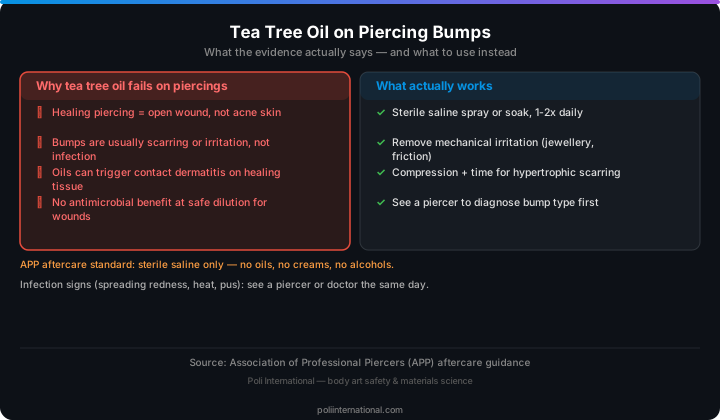
Tea tree oil versus saline for piercing bumps: why tea tree oil fails on healing piercings and why saline-only aftercare works
Infographic: Tea tree oil versus saline for piercing bumps: why tea tree oil fails on healing piercings and why saline-only aftercare works

1. How Tea Tree Oil Entered the Piercing Conversation

Search any piercing forum, Reddit thread, or YouTube comment section and you will find someone insisting that tea tree oil (Melaleuca alternifolia) cleared their bump in days. The recommendation has become so pervasive that many people treat it as equivalent to saline soaks.

The appeal is easy to understand. Tea tree oil has documented antimicrobial activity, it is cheap, and it sounds more natural than prescription treatments. For someone frustrated with a stubborn bump, a widely recommended home remedy feels like the logical next step.

Tea tree oil's active constituent, terpinen-4-ol, shows in vitro activity against Staphylococcus aureus and Propionibacterium acnes at concentrations of 5% to 10%. This is where the piercing-bump logic chain begins: a bump looks inflamed, tea tree oil is antimicrobial, therefore applying it should fix the bump. The chain sounds plausible. But wound healing is not simple chemistry, and a piercing channel is not a patch of acne-prone skin.

2. Why a Piercing Bump Is Not a Pimple

A piercing bump next to a healing nostril, helix, or cartilage piercing is usually one of three things, and none behaves like acne.

Hypertrophic scarring is the most common. Excess collagen deposited during healing produces a raised, firm, flesh-coloured lump at the piercing hole. Because the mechanism is connective tissue overproduction, not bacterial colonisation, antimicrobials have no role. These bumps respond to saline compresses, gentle pressure, and time.

Irritation is the second most common cause. Jewellery movement, poor fit, sleeping on the piercing, or harsh aftercare products produce redness and a bump that mimics infection. The fix is identifying and removing the irritant. Adding tea tree oil introduces a new chemical variable when the tissue needs fewer variables.

Infection is least common but most serious. Bacterial colonisation produces spreading redness, heat, swelling, and purulent discharge. This requires medical assessment, not a home remedy. Tea tree oil has a theoretical role only here, and it is weak compared to clinical evaluation and oral antibiotics.

For more on distinguishing bump types, see our guides on piercing bumps vs keloids and infection vs irritation.

3. What Goes Wrong When You Put Tea Tree Oil on Healing Tissue

Tea tree oil presents three distinct risks, and the most dangerous is not chemical.

Contact dermatitis. Undiluted tea tree oil is a known skin sensitiser. Even at 5% dilution, it can provoke allergic contact dermatitis. Oxidation products in older bottles increase sensitisation potential. A healing piercing channel is an open wound with fragile epithelium; exposing it to an essential oil introduces chemical stress the tissue does not need. The result is often a red, itchy patch larger than the original bump.

Moisture barrier disruption. Essential oils are lipophilic: they strip natural oils from the skin. On intact skin this causes dryness; on a healing channel it disrupts the epithelial barrier trying to close. The tissue must repair the chemical insult before resuming wound healing. Prolonged healing, not faster resolution, is the outcome.

Delayed diagnosis. This is the risk that matters most. Someone with an infected piercing, migrating jewellery, or a metal allergy treats it with tea tree oil for weeks instead of seeing a piercer. An abscess that could have been drained or an infection that could have been treated progresses while the person waits for an essential oil to work. In cartilage infections, that lost time can mean permanent deformity.

SituationTea tree oil helpful?Why
Closed, intact acne lesionPossibly, at 5%Some evidence for P. acnes reduction in vitro
Hypertrophic piercing bumpNoMechanism does not match pathology; irritation risk
Irritation bump (mechanical cause)NoAdding chemical irritant compounds the mechanical one
Infected piercingNoNot a substitute for medical assessment; delay risk is significant
Healed piercing, dry surrounding skinPossibly safe at 1-2% on surrounding skin onlyNo direct evidence; fragrance-free moisturiser is safer
From the Chief Engineer's Workbench

Patrick Poli · 25+ years in body-jewellery manufacturing

Patrick's Deep Archive

I have watched piercers argue about tea tree oil for twenty years, and the conversation has never settled. On one side, people who swear it flattened their bump in three days. On the other, piercers showing photographs of chemical burns from neat application on a two-week-old helix. Both sides are telling the truth as they experienced it. The problem is that anecdote is not mechanism, and mechanism is what matters when you are giving advice followed by thousands of people who cannot assess their own bump type.

Here is what I know from working with implant-grade materials for most of my career: healing tissue does not want an active ingredient. It wants to be left alone in a clean, stable environment. Every product you add is a variable. Every variable extends the healing timeline or introduces a new failure mode. Sterile saline is the standard because it adds nothing except moisture and gentle debris removal. That is the whole point.

Tea tree oil occupies a uniquely dangerous place in piercing culture because it is recommended so casually. Someone posts a blurry photo of a bump on a forum, and within five minutes a stranger who has never seen the jewellery, never assessed the angle, and never palpated the tissue has typed "tea tree oil, diluted, twice a day." That is not aftercare. That is a lottery ticket. If your bump is hypertrophic and resolves on its own while you apply the oil, you credit the oil. If it is an early infection and gets worse, you are in a doctor's office two weeks later than you should have been.

PPPatrick PoliChief Engineer · Creator of BioFlex® body jewelry

5. FAQ

Q: Can I use diluted tea tree oil on a healed piercing?

On a fully healed piercing (6-12 months for cartilage, 3-6 months for soft tissue), a 1-2% dilution on surrounding skin is unlikely to cause harm. There is no evidence of benefit, and you should keep it away from the fistula. A plain, fragrance-free moisturiser is safer for dry skin around a healed piercing.

Q: What if tea tree oil seems to be working on my bump?

Irritation bumps often resolve on their own once the original irritant is removed (touching, sleeping position), and the oil gets the credit. The drying effect can also temporarily flatten a raised scar, but the underlying collagen remains. If you think it is helping, ask whether you also changed something else at the same time.

Q: Are any essential oils safe for healing piercings?

No. Professional aftercare standards specify sterile saline only. Even chamomile, which has a better safety profile, is used on healed or nearly healed piercings, not fresh wounds. A healing piercing needs moisture balance and cleanliness, not botanical active ingredients.

Q: How long does a piercing bump take to resolve?

Hypertrophic scarring typically begins flattening within two to four weeks of consistent saline compresses and avoiding irritation. Complete resolution can take two to four months. Cartilage heals more slowly than soft tissue, and older bumps take longer. If there is no improvement after four weeks of correct aftercare, see your piercer.

Q: What should I do instead of using tea tree oil?

Identify the bump type first. For hypertrophic scarring: sterile saline compresses with gentle pressure for 5-10 minutes twice daily; if it persists beyond four weeks, ask a piercer about chamomile compresses or silicone scar discs. For irritation: identify and remove the irritant, check jewellery fit and material, and stop sleeping on it. See our aftercare science guide and infection vs irritation breakdown. For suspected infection or migrating jewellery, see our piercing rejection guide and consult a piercer or doctor.

6. Does Tea Tree Oil Get Rid of Piercing Bumps? What the Evidence and the APP Position Actually Say

If you found this page by searching "does tea tree oil get rid of piercing bumps" or "diluted tea tree oil for piercing bump," here is the direct answer: no, not reliably, and the dilution question misses the point. Tea tree oil has documented antimicrobial activity in vitro, but an irritation bump or hypertrophic scar on a healing piercing is not a bacterial problem. It is a mechanical one, caused by movement, pressure, moisture, or poor jewellery fit. No concentration of tea tree oil fixes a poorly angled piercing or a too-long barbell. The Association of Professional Piercers does not recommend tea tree oil for piercing bumps, and that position aligns with the clinical reality: applying an essential oil to an open wound introduces a chemical irritant that can delay healing and make the bump worse.

I have watched this cycle repeat for twenty-five years. Someone gets a bump, reads a forum thread, buys tea tree oil, dilutes it "just enough," and applies it twice a day. Two weeks later the bump is redder, the skin around it is dry and flaking, and they assume the piercing is infected. It rarely is. It is chemically irritated on top of whatever mechanical issue caused the bump in the first place. The oil did not get rid of anything, it added a second problem. That is why I tell people to stop and identify the cause before reaching for any topical product.

So what does work? First, confirm the bump is not an infection, spreading redness, heat, pus, or fever need a doctor, not a blog post. For a mechanical bump, the fix is boring and effective: stop touching it, keep it dry after cleaning with sterile saline, downsize the jewellery once swelling allows, and remove the source of friction. If the bump persists after those steps, a piercer can assess angle and fit. Tea tree oil is not on that list, and diluted tea tree oil is not a gentler version of the same idea, it is the same irritant at a lower dose.

If you want the full breakdown of what piercing bumps are and how to tell them apart from infections, read our guide to piercing bump causes and identification. And before you change jewellery to fix a fit issue, check our jewellery sizing guide so you get the length and gauge right the first time.

Conclusion

Tea tree oil occupies an unusual position in piercing aftercare: widely recommended, genuinely antimicrobial, and contraindicated for the purpose most people use it for. The gap between laboratory activity and safe application on a healing wound is real, and closing it requires understanding that most piercing bumps are hypertrophic scarring or irritation, not infections. These do not respond to antimicrobials; they respond to saline, pressure, correct jewellery, and time.

The saline-only rule is not conservative for its own sake. It is conservative because every additional product is a variable, and healing tissue heals fastest with the fewest variables. Tea tree oil is not uniquely harmful, but the casual way it is recommended online makes it uniquely risky. Before you reach for the bottle, reach for a diagnosis first.

Mind map · Tea Tree Oil for Piercing Bumps: Verdict

  • Tea Tree Oil on Bumps
    • Risks of Chemical Irritation

      Monarch Fine Jewelry advises against using tea tree oil because strong chemicals can cause additional irritation and chemical burns on healing skin.

      • Chemical burns on healing skin
      • Disrupted natural moisture barrier
      • Allergic contact dermatitis reactions
    • Proper Care with Sterile Saline

      The Association of Professional Piercers recommends sterile saline containing 0.9% sodium chloride as the only ingredient for gentle wound irrigation.

      • Isotonic 0.9% sodium chloride
      • Limit cleaning to twice daily
      • Gently pat the area dry
    • True Causes of Piercing Bumps

      Kirakira Piercing Company notes that piercing bumps are not infections but are most commonly caused by mechanical irritation and improper aftercare.

      • Pressure from sleeping on piercing
      • Friction from ill-fitting jewelry
      • Trauma from twisting jewelry
    • Seeking Medical Help Timely

      The Association of Professional Piercers guidelines state that minor clients and guardians must seek medical attention if a piercing infection is suspected.

      • Identify spreading infection symptoms
      • Consult physician for antibiotics
      • Keep jewelry inserted for drainage
StructureProcessMaterialHazard

4 branches, 0 sources. Each branch cites the article it came from; the labels beneath it are names, not claims.

Piercing Quiz

  1. 1. What active constituent in tea tree oil demonstrates in vitro antimicrobial activity against bacteria such as Staphylococcus aureus?

    • ✓ Terpinen-4-ol — Terpinen-4-ol is the key chemical component in tea tree oil shown in laboratory tests to inhibit bacteria at concentrations between 5% and 10%.
    • • Benzoyl peroxide — Benzoyl peroxide is a synthetic chemical compound used in acne medications, not an active constituent of tea tree oil.
    • • Salicylic acid — Salicylic acid is a beta-hydroxy acid used in chemical exfoliants rather than the active antimicrobial terpene in tea tree oil.
    • • Alpha-hydroxy acid — Alpha-hydroxy acids are organic acids used for skin exfoliation rather than the main antimicrobial constituent of tea tree oil.
  2. 2. What biological mechanism is directly responsible for hypertrophic scarring at a piercing site?

    • • Bacterial colonisation of the outer epidermal layer — Bacterial colonisation leads to active localized or spreading infections rather than connective tissue scarring.
    • ✓ Overproduction and excess deposition of collagen during healing — Hypertrophic scarring develops when connective tissue produces excess collagen while repairing the open wound channel.
    • • Stripping of natural lipophilic oils from the skin surface — Stripping lipophilic oils disrupts the cutaneous moisture barrier, leading to dryness and irritation rather than collagen overproduction.
    • • Allergic tissue reaction to implant-grade metals — Metal allergies provoke localized contact dermatitis or rejection rather than the excess collagen deposition that defines hypertrophic scarring.
  3. 3. Which group of symptoms specifically indicates a bacterial infection requiring medical assessment rather than routine irritation?

    • • A firm, flesh-coloured lump without swelling or temperature changes — A firm, flesh-coloured lump without heat or discharge is characteristic of hypertrophic scarring rather than an infection.
    • ✓ Spreading redness, localized heat, swelling, and purulent discharge — Spreading redness, heat, swelling, and pus formation are classical clinical indicators of bacterial colonisation in a wound.
    • • Minor localized dryness and itching surrounding a healed piercing — Minor dryness and itching on healed surrounding skin indicate moisture loss or mild topical irritation rather than infection.
    • • Temporary redness caused by sleeping directly on the piercing site — Temporary redness resulting from pressure during sleep reflects mechanical friction or pressure irritation rather than bacterial infection.
  4. 4. Why does applying essential oils like tea tree oil to a healing piercing channel disrupt the wound's moisture barrier?

    • ✓ Its lipophilic properties strip natural skin oils and break fragile repairing epithelium — As lipophilic substances, essential oils strip natural skin lipids and destroy the fragile epithelial barrier attempting to close the wound channel.
    • • It neutralizes the natural pH balance of sterile saline solution — Tea tree oil does not chemically react with or neutralize sterile saline solutions.
    • • It causes immediate breakdown of connective tissue collagen — Chemical trauma from tea tree oil causes severe irritation, but it does not degrade collagen directly.
    • • It completely seals the fistula opening and prevents oxygen transfer — Essential oils compromise wound healing primarily through lipid stripping and chemical sensitization rather than blocking airflow.
  5. 5. What is identified as the most consequential risk of applying home remedies like tea tree oil to a piercing bump?

    • ✓ Delayed diagnosis and clinical treatment of infections or severe issues — Relying on home remedies can dangerously delay proper evaluation and medical care for severe issues like cartilage infections or migrating jewelry.
    • • Rapid discoloration of implant-grade titanium jewelry — Essential oils irritate soft tissue, but they do not alter or discolor implant-grade metals.
    • • Permanent dark staining of surrounding epidermal skin layers — Essential oils can provoke chemical burns, but they do not cause permanent skin pigmentation changes.
    • • Immediate structural collapse of surrounding cartilage tissue — Cartilage deformities occur as a downstream consequence of untreated cartilage infection rather than immediate structural collapse from oil exposure.
  6. 6. What dilution level and application area are considered unlikely to cause harm on a fully healed piercing?

    • • Undiluted oil applied directly inside an unhealed wound channel — Applying undiluted essential oil directly to an open wound channel carries a high risk of contact dermatitis and severe irritation.
    • • A 5% to 10% dilution applied inside a fresh cartilage piercing — Using a 5% to 10% solution on a fresh wound channel causes tissue irritation and moisture barrier disruption.
    • ✓ A 1% to 2% dilution applied strictly to intact skin surrounding a healed piercing — A 1% to 2% dilution on surrounding intact skin around a fully healed piercing is unlikely to cause harm, though plain moisturizers are safer.
    • • A 20% solution mixed with rubbing alcohol applied twice daily to a bump — High concentrations mixed with harsh drying agents compound chemical burns and delay healing in open wounds.
  7. 7. What baseline aftercare approach is suggested by professional piercer guidelines to minimize variables during healing?

    • ✓ Applying sterile saline solution only, avoiding oils, creams, and alcohols — Professional aftercare guidelines suggest using sterile saline only to keep the wound clean without introducing unnecessary chemical variables.
    • • Alternating between tea tree oil and diluted hydrogen peroxide daily — Alternating harsh chemicals introduces multiple stress factors that disrupt fragile epithelium in a healing wound.
    • • Applying triple-antibiotic ointments twice daily until bumps disappear — Ointments and heavy creams trap moisture improperly and introduce unnecessary chemical ingredients into an open wound channel.
    • • Soaking the area twice daily in warm botanical oils — Essential oils are contraindicated for open piercing wounds, making simple saline compresses the preferred option.
  8. 8. How long does hypertrophic scarring typically take to begin flattening when managed with saline compresses and friction removal?

    • • 24 to 48 hours — Scar tissue remodeling requires weeks of consistent pressure and irritant removal rather than resolving in a few days.
    • ✓ 2 to 4 weeks — Raised hypertrophic scarring usually begins flattening within 2 to 4 weeks when managed with saline compresses and friction removal.
    • • 6 to 8 months — Initial flattening begins within weeks, whereas complete scar resolution may extend over several months.
    • • 12 to 18 months — Bumps that take over a year to show initial flattening likely stem from unaddressed mechanical irritants or misdiagnosis.
  9. 9. If a hypertrophic piercing bump shows no improvement after four weeks of proper care, what non-chemical option may a piercer recommend?

    • • Applying undiluted essential oils directly into the wound channel — Undiluted essential oils provoke contact dermatitis and compound tissue damage.
    • ✓ Using silicone scar discs or chamomile compresses — Piercers may suggest silicone scar discs or chamomile compresses if standard saline compresses do not yield progress after four weeks.
    • • Swabbing rubbing alcohol over the site to dry out scar tissue — Rubbing alcohol causes severe dehydration and chemical irritation on healing tissue.
    • • Soaking the piercing in concentrated tea tree oil twice daily — Concentrated tea tree oil application adds chemical stress to tissue that requires stabilization.
  10. 10. Why might someone mistakenly credit tea tree oil with curing their piercing bump?

    • • Tea tree oil permanently dissolves deep keloid tissue within hours — Essential oils do not have the capacity to dissolve dense collagen scar tissue or keloids.
    • ✓ The bump resolved naturally after an irritant was removed, or drying flattened it temporarily — Bumps often resolve naturally when underlying friction or pressure is eliminated, or drying effects temporarily shrink surface appearance while collagen remains.
    • • The oil sterilizes internal scar collagen, causing immediate tissue absorption — Essential oils cannot enter connective tissue to sterilize or break down collagen fibers.
    • • Essential oils chemically re-align misaligned cartilage bones — Cartilage is a flexible connective tissue, and botanical oils cannot alter structural skeletal components.
  11. 11. What are the standard complete healing timeframes given for soft tissue versus cartilage piercings?

    • • 1-2 weeks for soft tissue, 3-4 weeks for cartilage — Wound channels through soft tissue or cartilage require months rather than a few weeks to re-epithelialize fully.
    • ✓ 3-6 months for soft tissue, 6-12 months for cartilage — Complete healing typically takes 3 to 6 months for soft tissue piercings and 6 to 12 months for cartilage piercings.
    • • 6-12 months for soft tissue, 2-3 years for cartilage — Soft tissue piercings finish healing within 6 months, while cartilage rarely requires multiple years under standard conditions.
    • • 1-2 months for soft tissue, 1-2 months for cartilage — Cartilage heals significantly slower than soft tissue due to limited blood supply, making their timelines distinct.

Extended Reference Table

8 of 8 rows

Extended reference table generated from the article and its verified research sources. Bracketed numbers jump to the matching entry in the Technical References below.

SafetyItem, Practice, or Standard Category Description and Purpose Compliance and Specifications Usage Instructions Contraindications and Risks Source
✅0.9% Sodium Chloride (Sterile Saline)Aftercare SolutionA pharmaceutical-grade, pH-balanced, isotonic solution used to irrigate wounds, flush debris, and restore natural pH without damaging healing tissue.USP Grade; 0.9% concentration; sterile; preservative-free; no added fragrances or oils.Apply a fine mist to the entry and exit of the piercing 1-3 times daily. Let sit to soften debris, then pat dry with disposable paper.Over-cleaning (more than 3 times daily) can dry out skin; avoid non-sterile homemade mixtures which can introduce bacteria or have inconsistent concentrations.[5], [6]
✅IrrigationClinical PracticeA hands-off cleansing method using liquid to physically flush out cellular debris, lymph (crusties), and pollutants from a piercing channel.360-degree mist technology or clean running water.Use a saline spray to flush the area from various angles or allow clean shower water to run gently over the site.Manual scrubbing, twisting, or sliding jewelry during irrigation can cause micro-tears in fragile new tissue and lead to irritation bumps.[5], [6]
✅DownsizingClinical PracticeThe professional replacement of initial longer jewelry posts with shorter, better-fitting ones after initial swelling has subsided.Performed by a professional piercer using sterile, medical-grade jewelry.Schedule a follow-up appointment between 2-8 weeks (depending on anatomy) to ensure the post fits flush with the tissue.Failure to downsize can lead to jewelry tilting, migration, permanent angle distortion, or "snagging" on clothing and hair.[5], [6]
✅Implant-Grade MaterialsMedical-Grade MaterialHigh-quality, non-porous metals or glass used for initial piercings to provide a hypoallergenic environment that will not harbor bacteria.ASTM F-136 (Titanium); ISO standards for surgical steel; Lead-free; Nickel-free.Used as primary jewelry for new piercings to support stabilization during the entire healing phase.Lower quality materials or acrylics can lead to metal allergies, rejection, infection, or chronic irritation.
✅Anatomical Healing StandardsClinical StandardThe physiological timeline and process of tissue repair, which typically progresses from the outside-in.Varies by site: Lobes (6-8 weeks), Cartilage (4-12 months), Septum (6-10 weeks), Navel (8-12 months).Maintain consistent cleaning routines for the full duration of the recommended period even if the exterior looks healed.Assuming a piercing is healed because the surface looks fine can lead to internal injury or infection if care is stopped prematurely.[5], [6]
⚠️Disposable Paper Products / Non-woven GauzeAftercare MaterialSingle-use, non-textile materials used to dry the piercing site or remove stubborn debris while minimizing bacteria transfer.Medical-grade non-woven gauze; clean, single-use paper towels.After rinsing, gently pat the area dry or use saline-dampened gauze to wipe away softened debris.Cloth towels are contraindicated as they harbor bacteria and can snag on jewelry; woven gauze may leave fibers in the wound.[5]
✅Hands-Off PolicyAftercare PracticeThe foundational practice of avoiding physical contact and movement of jewelry to allow the healing channel to form.Zero manual rotation or spinning of jewelry.Do not touch, twist, or spin the jewelry; only handle the area with thoroughly washed hands when necessary for cleaning.Movement irritates the healing piercing channel, introduces bacteria, and disrupts the formation of new skin cells.[5]
✅Botanical Materials (Jojoba / Rosehip Oil)Botanical MaterialNatural extracts used to hydrate skin, maintain elasticity, and assist in tissue restoration after the initial healing phase.Organic; cold-pressed; unrefined.Massage onto piercings that have passed the initial healing phase or use for stretched lobe maintenance once the wound is closed.Not for use on fresh or open wounds as they may trap bacteria in the piercing channel or cause chemical irritation.

Free Body Art Wall Posters

Print-ready reference posters for your studio or your own wall. Free to download and display, embed on your own site with attribution. Click any poster to preview it full size before downloading.

Choose and download all 40 posters

Technical_References_Archive

  • [1]Carson CF, Hammer KA, Riley TV. Melaleuca alternifolia (Tea Tree) Oil: a review of antimicrobial and other medicinal properties. Clin Microbiol Rev. 2006;19(1):50-62. PMID 16418522.
  • [2]de Groot AC, Schmidt E. Tea tree oil: contact allergy and chemical composition. Contact Dermatitis. 2016;75(3):129-143. PMID 27173437.
  • [3]Hammer KA, Carson CF, Riley TV. Antifungal activity of the components of Melaleuca alternifolia (tea tree) oil. J Appl Microbiol. 2003;95(4):853-860. PMID 12969301.
  • [4]Association of Professional Piercers (APP). Suggested Aftercare Guidelines for Body Piercings. safepiercing.org. Accessed 2026. safepiercing.org/wp-content/uploads/2020/05/APP_B...
  • [5]Aftercare - Association of Professional Piercers: safepiercing.org/aftercare
  • [6]Aftercare Minors - Association of Professional Piercers: safepiercing.org/aftercare-minors

About the Author

PP

Patrick Poli

Chief Engineer, Poli International · Creator of BioFlex® body jewelry

Patrick has spent 25+ years manufacturing body jewellery and studio equipment, and is the creator of BioFlex® body jewelry. He created the push-fit system so jewellery separates on impact instead of tearing the piercing. He also reworked the push-fit discs in medical-grade soft polymer, EO-sterilised, for people fighting bumps and keloids.

More about Patrick →

Last reviewed: 2026-10-15 · Published: 2026-07-28

Continue Reading