Shop
Body Art News

The Tattoo That Turns Off in Sunlight—and Back On Under UV

PP

Chief Engineer

Patrick Poli

Journal Date

2026-10-11

Last Reviewed

2026-10-12

Treat “smart ink” as an experiment, not a finished tattoo product

Key Takeaways:
» A new multicolour tattoo ink reportedly fades in sunlight and reappears under ultraviolet light within seconds, but human safety remains unresolved.
» A colour change is not the same as pigment removal: the material may still remain in the skin after it becomes visually invisible.
» Tattoo artists should not use experimental photoresponsive ink on clients without full toxicology, sterilization, labeling, and regulatory documentation.
» Clients should ask whether an ink has been tested for long-term skin, immune-system, photochemical, and laser-interaction effects.
» “It worked on the inventor” is not clinical evidence; it is the beginning of a safety question.

1. A Tattoo That Behaves Like a Light Switch

The most interesting body-art story this week is not another celebrity tattoo or a clip of somebody making a questionable piercing in a car park. It is a reported multicolour tattoo ink that fades in sunlight and returns under ultraviolet light—a visual effect that makes ordinary tattoo pigment look technologically ancient.

According to coverage from Live Science’s report on tattoos that can turn on and off, the chemistry relies on a photoresponsive effect: exposure to sunlight changes the visible state of the colour, while ultraviolet light restores or reveals it. A separate report describes the ink as fading in sunlight and reappearing under UV within seconds, with the developer having tested it on himself.

That is clever chemistry. It is not yet a client-ready tattoo system.

The first mistake people make is calling this vanishing ink. A tattoo that looks clear is not necessarily a tattoo whose material has left the dermis. Conventional tattoo pigment is deposited in the dermis, where particles are taken up and retained by cells including macrophages. A photoresponsive pigment may alter its optical absorption without disappearing from the tissue. The colour can go away while the material remains exactly where the needle put it.

That distinction matters. “Invisible” is a visual description, not a toxicological one.

The second mistake is treating the word ink as if it describes one thing. A tattoo formulation is a system: colourant, carrier, dispersant, preservatives, contaminants, particle-size distribution, packaging, and sterilization status. The new technology may be perfectly interesting at the molecular level while still being incomplete as a sterile injectable product.

That is the difference between a laboratory demonstration and a professional tattoo supply.

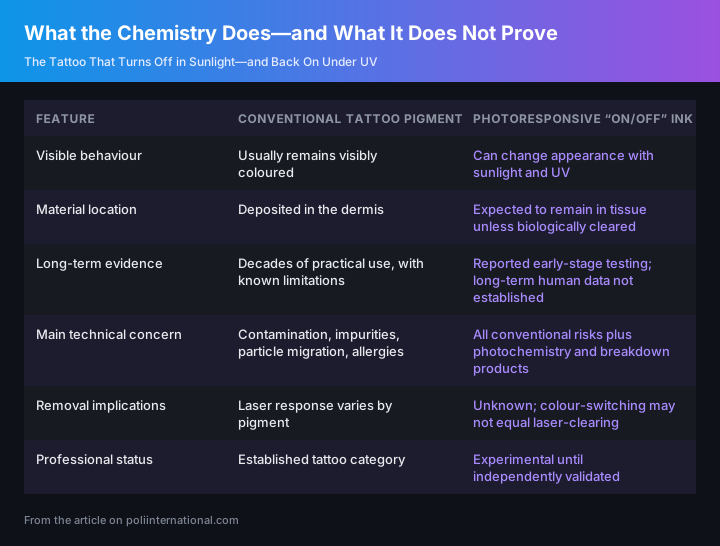
2. What the Chemistry Does—and What It Does Not Prove

Photoresponsive materials can change colour because light alters the molecular arrangement or electronic state of a compound. In plain language, photons push the molecule into a different configuration, and that configuration absorbs or reflects light differently. The observer sees a colour change; the skin sees a foreign material.

FeatureConventional tattoo pigmentPhotoresponsive “on/off” ink
Visible behaviourUsually remains visibly colouredCan change appearance with sunlight and UV
Material locationDeposited in the dermisExpected to remain in tissue unless biologically cleared
Long-term evidenceDecades of practical use, with known limitationsReported early-stage testing; long-term human data not established
Main technical concernContamination, impurities, particle migration, allergiesAll conventional risks plus photochemistry and breakdown products
Removal implicationsLaser response varies by pigmentUnknown; colour-switching may not equal laser-clearing
Professional statusEstablished tattoo categoryExperimental until independently validated
What the Chemistry Does—and What It Does Not Prove
Infographic: What the Chemistry Does—and What It Does Not Prove

The most important unknown is not whether the colour changes. The report already indicates that it does. The important unknown is what the molecule becomes after repeated cycles of sunlight and ultraviolet exposure.

Every reversible chemical system has to move between states. That may be harmless, or it may produce degradation products over time. The relevant questions include:

- Does the material remain chemically stable after hundreds or thousands of light cycles?
- Does ultraviolet exposure generate reactive oxygen species?
- Does the pigment break into smaller particles that migrate more readily?
- Are the breakdown products more inflammatory than the original compound?
- Does sunlight heat the tattoo area enough to change release or irritation behaviour?
- What happens when the material is exposed to a Q-switched or picosecond laser?

The industry has already learned that a pigment’s apparent colour is a poor proxy for its safety. The same lesson applies here, with an extra layer of chemistry attached.

Artists and clients should also understand that sunlight is not a laboratory switch. Solar exposure varies with latitude, season, cloud cover, skin tone, sunscreen, clothing, angle, and duration. Ultraviolet lamps vary in wavelength and intensity. A material that responds neatly to a controlled light source may behave unevenly across a real tattoo, producing patchiness rather than a clean off-state.

Skin is not a white sheet of paper. It scatters light, contains melanin, changes thickness across the body, and heals at different speeds. The same formula may look dramatically different in the forearm, ankle, sternum, or heavily pigmented skin.

3. The Regulatory and Clinical Gap

The developer reportedly described the ink as safe in initial testing, but the available reporting does not establish the evidence needed for routine tattoo use. The most important sentence in the coverage is the least glamorous one: the safety of the inks for other people has not yet been determined.Live Science’s account makes that limitation clear.

That is not an insult to the invention. It is the normal order of work.

A credible tattoo formulation needs more than a successful self-application. At minimum, a professional evaluation should address:

- Identity and purity: the exact chemical composition, impurities, residual solvents, heavy metals, and undeclared additives.
- Sterility assurance: validated processing, sealed packaging, lot identification, expiry dating, and microbiological testing.
- Biocompatibility: irritation, sensitization, cytotoxicity, genotoxicity, and implantation-relevant testing.
- Photostability: repeated exposure to UVA, UVB, visible light, and realistic solar doses.
- Degradation analysis: identification of every meaningful breakdown product, not just the original pigment.
- Particle behaviour: size distribution, aggregation, migration, and persistence in tissue.
- Laser interaction: thermal and photochemical effects under tattoo-removal wavelengths.
- Clinical follow-up: not merely whether the tattoo looks good at six weeks, but what happens over months and years.

For studios, the practical rule is brutally simple: do not put an experimental light-responsive ink into a client because the video is impressive.

A professional should be able to obtain a safety data sheet, certificate of analysis, ingredient disclosure, lot traceability, sterilization documentation, intended-use statement, and jurisdiction-specific compliance information. If the supplier cannot provide those documents, the product belongs in a laboratory or demonstration setting—not in someone else’s skin.

There is another issue that social media will ignore because social media is paid in novelty. If the tattoo becomes invisible in sunlight but remains in the dermis, clients may assume they have removed it. They have not. The psychological and consent implications are obvious: someone may take a “temporary” decision believing the material will simply switch off, then discover that the tattoo remains chemically present, reacts unpredictably, or becomes visible under a different light source.

That makes informed consent essential. A client must be told whether the effect is reversible appearance, biological clearance, or merely optical masking. Those are three different claims.

The comparison with standard tattoo ink regulation is also instructive. Recent reporting on the evolving shift from tattoo-ink composition limits toward exposure-based risk assessment shows why regulators increasingly care about what a substance does in the body, not simply whether its ingredient list looks familiar. A photoresponsive pigment adds a new exposure pathway: repeated light activation.

That does not make it dangerous by definition. It makes it deserving of more testing than a static colourant, not less.

4. Patrick's Note: The Demonstration Is Not the Product

A colour-changing tattoo is a brilliant demonstration because it answers the easiest question: Can the chemistry change what the eye sees? The harder question is whether the same chemistry can sit in human skin for years without producing a problem nobody can reverse.

The industry has a bad habit of confusing novelty with readiness. A tattoo artist is not a chemistry laboratory with a consent form, and a client is not a convenient extension of the inventor’s pilot study. The responsible next step is independent testing, proper documentation, and a very boring period in which nobody rushes to tattoo strangers.

I have written before about why tattoo materials must be evaluated as regulated body-contact products rather than treated like ordinary cosmetics. The same principle applies here with greater force: if light changes the material, light exposure belongs in the safety file.

5. FAQ: Technical Q&A

Q: If the tattoo disappears in sunlight, has the pigment left my skin?

No. A visible colour change does not prove that the material has been removed from the dermis. The molecules may still be present but absorbing and reflecting light differently.

Q: Can an artist safely offer this ink if the inventor has used it on himself?

No. Self-testing demonstrates that the product can be applied and observed; it does not establish long-term safety for clients. Before use, the artist needs independent toxicology, sterility, composition, photostability, and regulatory documentation.

Q: Could sunlight make the tattoo harmful?

It could, which is why photodegradation testing matters. Repeated UVA and UVB exposure may leave the original material unchanged, or it may create breakdown products with different biological effects; without analytical testing, nobody can responsibly claim which outcome applies.

Conclusion: Wait for the Evidence

The engineering achievement is real: a tattoo pigment that changes visible state under different light conditions is an elegant application of photoresponsive chemistry. The consumer claim is not yet established. A tattoo that switches off visually is not the same thing as a tattoo that has safely disappeared.

For artists, the action is straightforward: demand full documentation and refuse unvalidated client use. For clients, ask one question before getting excited by the video: what happens to the material in your skin after the colour changes? Until that answer comes with independent data, the safest place for the ink is outside the body. The difference between an impressive tattoo-ink claim and a defensible studio standard is paperwork backed by chemistry.


Further Reading

  • Finger Piercings Are Trending. The Hand Is Not a Piercing Site.
  • The Gas-Station Tattoo Was Staged. The Safety Problem Wasn’t.
  • The Mobile Tattoo Ban Gets the Hygiene Question Right—and the Engineering Question Wrong
  • Mind map · The Tattoo That Turns Off in Sunlight—and Back On Under UV

    • Photochromic Smart Tattoo Ink
      • Light Responsive Optical Mechanism

        Photoresponsive tattoo ink alters its optical absorption under sunlight and ultraviolet light while remaining physically deposited within dermal tissue.

        • Reversible Molecular Color Changes
          • UV Light Restores Visibility
        • Optical Masking Versus Removal
          • Pigment Remains in Dermis
      • Photochemical and Stability Risks

        Repeated exposure to ultraviolet light and sunlight may generate reactive oxygen species or produce harmful chemical degradation products.

        • Photodegradation and Chemical Stability
          • Reactive Oxygen Species Generation
          • Unpredictable Laser Removal Response
        • Uneven Environmental Light Response
      • Clinical and Regulatory Validation

        Professional tattoo application requires independent toxicology, sterility assurance, photostability testing, and complete regulatory compliance documentation.

        • Required Safety Testing
          • Sterility Assurance and Purity
          • Biocompatibility and Cytotoxicity
        • Professional Studio Standards
      • Informed Consent and Expectations

        Tattoo clients must receive clear disclosures distinguishing temporary optical masking from permanent material presence and biological clearance.

        • Disclosing Permanent Material Presence
          • Clarifying Optical Masking Claims
        • Self Testing Versus Clinical Evidence
    StructureProcessMaterialHazard

    4 branches, 0 sources. Each branch cites the article it came from; the labels beneath it are names, not claims.

    Tattoo Safety Quiz

    1. 1. When a photoresponsive tattoo ink becomes visually clear or 'turns off' in sunlight, what is actually occurring within the skin?

      • • The pigment particles are absorbed by macrophages and permanently cleared from the body. — Visual invisibility does not mean the material has left the dermis or been biologically cleared.
      • ✓ The pigment remains in the dermal tissue, but its optical absorption state has changed. — Photoresponsive compounds alter their visible light absorption configuration without physically exiting the tissue.
      • • The carrier liquid evaporates under solar heat, leaving no solid material behind. — Carrier solutions disperse during normal initial healing rather than disappearing and reappearing in response to light.
      • • The solar light energy permanently breaks chemical bonds, destroying the pigment completely. — The reported technology is reversible under ultraviolet light, proving the pigment molecule is not permanently destroyed.
    2. 2. Why is evaluating a photoresponsive tattoo ink based solely on the active dye molecule considered incomplete from a safety standpoint?

      • ✓ A complete tattoo ink is a complex system including carriers, dispersants, preservatives, and potential contaminants. — Injectable product safety depends on the entire sterile multi-component system rather than just the isolated active dye molecule.
      • • The dye molecule shifts weight rapidly, preventing standard laboratory chemical analysis. — Molecular weight remains stable during light switching, so standard analytical chemistry can still identify the compound.
      • • Tattoo inks must be custom-formulated at the client's skin surface during the application process. — Professional inks are manufactured as pre-formulated sterile liquids rather than mixed directly on skin during tattooing.
      • • Photoresponsive compounds neutralize all standard preservative agents instantly. — Preservative compatibility is a formulation factor, not an inherent property that instantly destroys preservative molecules.
    3. 3. What is a major toxicological concern associated with subjecting photoresponsive pigments to repeated cycles of light exposure?

      • • The light switch consumes local oxygen, starving surrounding epidermal cells. — Light activation relies on molecular photon absorption rather than systemic cellular oxygen depletion.
      • ✓ Repeated switching cycles may create chemical breakdown products or reactive oxygen species over time. — Reversible photochemical reactions can degrade molecular structures, generating potentially toxic or inflammatory byproducts.
      • • Ultraviolet light exposure causes the ink to freeze into a solid permanent mass instantly. — The light response is designed to switch fluidly between states rather than forming irreversible solid clumps.
      • • Solar exposure alters the body's genetic code at the tattoo site within hours. — While photodegradation can create chemical byproducts, direct genetic transformation of the entire host site is an unfounded claim.
    4. 4. Why might photoresponsive ink exhibit uneven patchiness during solar exposure rather than a uniform 'off' switch across a tattoo?

      • ✓ Skin scatters light non-uniformly and varies in melanin, thickness, and real-world solar radiation angles. — Real skin optics and inconsistent natural light exposure prevent uniform photon distribution across the entire tattooed area.
      • • Sunlight selectively destroys dark pigment particles while leaving light particles completely untouched. — Patchiness stems from variable light penetration and physiological scattering rather than selective particle destruction.
      • • Tattoo needles push ink exclusively into the bloodstream where it circulates unevenly. — Tattoo ink is deposited into dermal tissue where it remains stationary rather than freely circulating in blood vessels.
      • • Ultraviolet radiation repels photoresponsive molecules toward the outer edges of the design. — Photons change molecular states on site without exerting mechanical forces that push physical particles across skin.
    5. 5. Why is an inventor's successful self-testing of a photoresponsive ink insufficient to clear the ink for routine client use?

      • • Self-testing is legally classified as an automatic regulatory violation in all jurisdictions. — While self-testing shows early proof of concept, safety validation requires broader systematic protocols rather than simple legal bans.
      • ✓ A single self-trial lacks independent toxicology, photostability testing, biocompatibility assays, and broad population data. — Demonstrating that a material can be applied without immediate failure does not evaluate long-term toxicological safety across diverse populations.
      • • Self-applied tattoos fail to activate the body's normal macrophage immune response. — Immune responses to foreign pigments occur regardless of who operates the tattoo machine.
      • • Photoresponsive inks only respond to light when applied by a licensed medical physician. — Chemical reactions to photons depend entirely on physical exposure rather than the credentials of the practitioner.
    6. 6. What core documentation should a tattoo studio obtain to verify that an ink product meets professional standards before client use?

      • • A social media video illustrating the pigment changing color in under ten seconds. — Visual demonstrations prove optical behavior but offer no evidence regarding sterility, purity, or chemical safety.
      • ✓ A safety data sheet, certificate of analysis, lot traceability, and sterility documentation. — Defensible studio standards rely on verifiable analytical, chemical, and microbiological testing paperwork.
      • • A signed liability release from the client exempting the studio from regulatory oversight. — Client waivers cannot substitute for manufacturer compliance documents and verified product safety files.
      • • A written endorsement from an industry trade group certifying aesthetic popularity. — Trade association guidance or popularity does not replace official regulatory, chemical, and analytical safety records.
    7. 7. What distinction is essential for client informed consent regarding light-switchable tattoo ink?

      • • Clarifying that the tattoo is temporary and will naturally vanish within months. — Describing invisible ink as temporary misleads clients because foreign chemical material remains fixed in the dermal tissue.
      • ✓ Explaining that the effect is reversible optical appearance, not biological clearance of material from the body. — Proper consent requires informing clients that invisible ink is an optical effect while the foreign substance stays in the skin.
      • • Assuring the client that photoresponsive ink renders skin completely immune to sunburn. — Color-changing inks offer no photoprotective benefit to surrounding epidermal tissue.
      • • Confirming that light-responsive inks do not require standard skin penetration hygiene. — Injecting any ink requires full sterile technique regardless of the pigment's chemical properties.
    8. 8. What key issue complicates the removal of photoresponsive tattoo ink using conventional laser technology?

      • • Laser energy is completely reflected by transparent molecules, making absorption impossible. — Molecular reflection dynamics vary, but claiming complete energy deflection is scientifically unfounded.
      • ✓ Laser interactions under intense removal wavelengths may produce unknown photochemical or thermal breakdown risks. — High-energy laser pulses applied to light-sensitive switching compounds can cause unpredictable chemical reactions or cleavage.
      • • Photoresponsive pigments permanently convert into natural melanin under laser light. — Lasers break foreign pigments into smaller clearance fragments rather than converting synthetic dyes into human skin melanin.
      • • Lasers cannot target pigments that have been taken up by dermal macrophages. — Laser removal specifically targets pigment particles residing inside dermal macrophages.
    9. 9. What unique evaluation step must light-activated tattoo ink undergo that standard static tattoo pigments do not require?

      • • Sterility testing before sealed packaging. — All tattoo inks require sterility assurance, making this standard across both traditional and experimental categories.
      • ✓ Assessing molecular stability and breakdown products after repeated long-term light cycling. — Because the ink switches states upon light exposure, testing must verify safety across thousands of light-activation cycles.
      • • Heavy metal purity testing in analytical laboratories. — Heavy metal analysis is a conventional safety requirement for all tattoo pigments regardless of light responsiveness.
      • • Verifying dermal placement depth with ultrasound imaging. — Placement depth is controlled by needle setting and artist technique rather than pigment-specific laboratory testing.

    Extended Reference Table

    8 of 8 rows

    Extended reference table generated from the article and its verified research sources. Bracketed numbers jump to the matching entry in the Technical References below.

    SafetyItem / Material / Practice Category Regulatory / Standard Status Health & Safety Considerations
    ✅Primary Aromatic Amines (PAAs)Contaminant / Impurity in tattoo inksREACH Restriction (Annex XVII Entry 75): Limit value for free PAAs is 0.0005% (5 ppm)Released from azo pigments; can be tested via LC-MS/MS following DIN EN ISO 14362-1 or DIN EN 71-7.
    ✅Benzo[a]pyrene (BaP)Polycyclic Aromatic Hydrocarbon (PAH)REACH Restriction (Annex XVII Entry 75): Limit concentration is 0.0000005% (5 ppb)Classified as carcinogenic or mutagenic category 1A, 1B or 2 under Regulation (EC) No 1272/2008. Determined via ASTM D8143-17 in carbon black.
    ✅BenzeneSolvent impurityREACH Restriction (Annex XVII Entry 75): Limit value 0.00005%Classified as Carcinogen Category 1A (Carc 1A). Analyzed via Headspace GC-MS.
    ✅NickelHeavy Metal ImpurityREACH Restriction (Annex XVII Entry 75): Limit value 0.0005% (5 ppm)Analyzed using pressure digestion followed by ICP-MS (DIN 11699 / K 84.00-31) or ICP-OES (K 84.00-32). Potential skin sensitizer.
    ✅MercuryHeavy Metal ImpurityREACH Restriction (Annex XVII Entry 75): Limit value 0.00005% (0.5 ppm)Analyzed by cold vapour atomic absorption spectrometry (AAS) after pressure digestion according to K 84.00-29 and K 84.00-33.
    ✅OECD Test Guideline 491 (Short Time Exposure In Vitro Test Method)Testing Standard / MethodOECD Standard Test GuidelineEvaluates eye irritation/damage potential using cell cultures; positive results exclude pigment use in tattoo inks.
    ✅OECD Test Guideline 439 (In Vitro Skin Irritation: Reconstructed Human Epidermis Test Method)Testing Standard / MethodOECD Standard Test GuidelineAssesses skin irritation and corrosion potential; allows classification as skin irritant/corrosive (Cat 1 or 2) or non-irritant.
    ✅OECD Test Guideline 432 (In Vitro 3T3 NRU Phototoxicity Test)Testing Standard / MethodOECD Standard Test GuidelineAssesses phototoxicity of tattoo pigments absorbing light between 290-700 nm; evaluated via HPLC/UPLC spectrometry.

    Free Body Art Wall Posters

    Print-ready reference posters for your studio or your own wall. Free to download and display, embed on your own site with attribution. Click any poster to preview it full size before downloading.

    Choose and download all 40 posters

    Technical_References_Archive

    About the Author

    PP

    Patrick Poli

    Chief Engineer, Poli International · Creator of BioFlex® body jewelry

    Patrick has spent 25+ years manufacturing body jewellery and studio equipment, and is the creator of BioFlex® body jewelry. He created the push-fit system so jewellery separates on impact instead of tearing the piercing. He also ran 10 to 25 minute consultations before piercing, and treats aftercare as a standing invitation rather than a leaflet.

    More about Patrick →

    Last reviewed: 2026-10-12 · Published: 2026-10-11

    Continue Reading