
On 9 October 2026, Carson J. Bruns and colleagues at the University of Colorado Boulder published a peer-reviewed paper in Cell Press's Matter & Light describing PhotoTat: a set of full-color tattoo inks whose pigments switch between an invisible state and a saturated visible state under specific wavelengths of light. The paper reports the inks on silicone mannequin arms and, for successive formulations, on the lead author's own skin. If that sounds like a novelty item, read the materials section first. The interesting part is not that ink can be hidden. It is how the pigment is packaged, how long it survives in dermis, and what nobody has measured yet.
1. What the paper actually describes
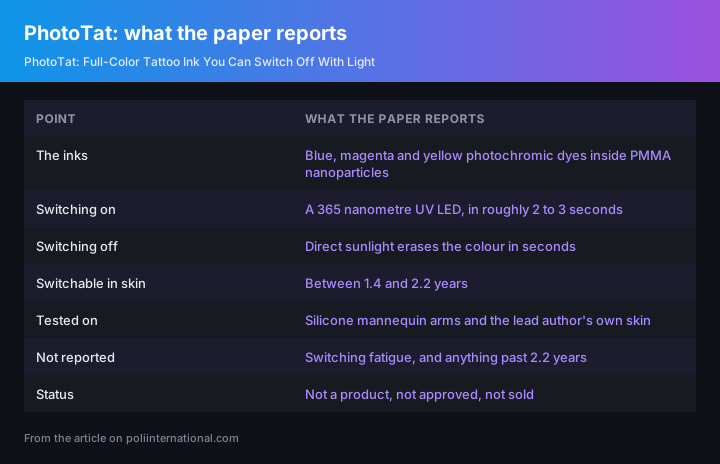
PhotoTat is three primary inks: blue, magenta and yellow. Each is a photochromic dye encapsulated inside a polymethyl methacrylate (PMMA) nanoparticle. A 365 nanometre ultraviolet LED activates the pigments in roughly 2 to 3 seconds. Under ordinary indoor lighting the activated colour persists for hours to days. Direct sunlight erases it in seconds, because the same broadband visible intensity that drives the reversible photoreaction also drives it back.
The mechanism is a molecular geometry change, not a chemical reaction that consumes the molecule. Photochromic dyes absorb a specific wavelength, rearrange their structure (the classic ring-opening and ring-closing behaviour), and their absorption band shifts. A transparent compound becomes a coloured one. Because different dye families respond to different wavelengths, each colour channel can be addressed separately: blue light activates the yellow channel, green light activates the magenta one. Mixing three channels gives full colour, which is what separates this from the single-colour switchable ink that reached human trials earlier in 2026.
2. The engineering is the PMMA shell, not the dye
Photochromic chemistry is decades old. It sits in every transition lens. What is new here is the delivery vehicle. PMMA is a medical-grade, glass-like polymer already used in medical implants and dermal fillers. The dye is locked inside a solid polymer microsphere instead of being dissolved in a liquid carrier.
That distinction carries most of the technical weight:
- Encapsulation isolates the dye from tissue fluid and immune surveillance. A free photochromic small molecule in the dermis can diffuse, be metabolised, or act as a hapten. A molecule trapped in a solid polymer bead cannot.
- It removes the solvent problem. Conventional inks rely on a liquid carrier that disperses pigment and then leaves as the wound closes. Here the particle is the carrier and it stays put.
- Particle size governs retention. Large solid spheres are cleared slowly, which is why the reported switching lifetime is measured in years rather than weeks.
The caveat is worth stating plainly: "medical-grade material already used in fillers" is not the same claim as "safe as an intradermal tattoo pigment". PMMA is used in dermal fillers as a permanent implant, and filler granuloma is a documented complication. Encapsulation reduces dye exposure, but it introduces a permanent particulate load, which is precisely the failure class the industry is already arguing about in the MRI artefact and pigment migration literature.
3. Durability is the best number and the weakest claim
The strongest result in the paper is that all three channels remained switchable in skin for between 1.4 and 2.2 years. That is longer than any previously published intradermal photoswitchable system.
It is also where the evidence stops. Three questions follow directly from those numbers:
- What is the fatigue curve? Every on and off cycle consumes some fraction of the molecules still able to switch. The paper reports the window, not the cycle count that survives it.
- What degrades first, the dye or the shell? A fatigued dye inside an intact PMMA bead is cosmetically harmless. A cracked bead that releases photodegradation products into the dermis is a different problem entirely.
- What happens at year three? There is no data past 2.2 years, and a tattoo is a 40-year decision.
There is also the sample question. Iterative self-tattooing by the lead author demonstrates feasibility. It is not a safety cohort, and it cannot be presented as one.
4. What this changes for a studio
Nothing about the delivery mechanics. PhotoTat is still a particulate suspension driven into the dermis with a needle. Same aseptic chain, same single-use cartridge and barrier film, same aftercare, same licensing regime, same cross-contamination rules. If a supplier ever ships it, it goes in the same machine with the same protocol.
What it does change is the client conversation, and studios should be ready for it:
- "Can you turn it off?" Only the PhotoTat channels, and only under the right wavelength. A conventional black outline stays exactly where it is.
- Reversibility is not removal. When the colour is switched off, the tattoo is visually gone but materially present. The particles are still in the dermis.
- Clients who reject permanence on principle may now have an option, which expands the market rather than cannibalising it.
- Medical use is the most credible application in the paper: radiotherapy alignment marks that can be switched on for beam set-up and switched off afterwards, instead of leaving a permanent reminder of treatment.
5. Regulation: the same gap, one layer deeper
Neither major jurisdiction has a mechanism to evaluate this class of pigment before it reaches a studio.
In the United States, tattoo inks are regulated as cosmetics through the colour additive framework, and there is no pre-market approval requirement for intradermal injection. In the European Union, REACH Annex XVII entry 75 restricts specific pigments by name. That is a negative list of known hazards, not an approval pathway for novel chemistries. A photochromic dye encapsulated in PMMA particles is not assessed by that list at all.
That means no framework currently requires a fatigue study, a particle migration study, or a multi-year retention study for a photoswitchable intradermal pigment. This is the same structural gap Poli International covered in August 2026, when the first single-colour photochromic ink entered human trials with eleven participants and industry-affiliated authorship. PhotoTat is the same research lineage with more capability: multicolour instead of one channel, faster activation, and the longest documented switching durability to date.
The practical consequence is unchanged. The data will sit with the supplier. Studios will have to ask for it, in writing, before it goes anywhere near a client.
Bottom line
PhotoTat is a genuine materials result. It is not a product, it is not approved, and it has not been sold. Treat it as a strong signal about where ink chemistry is heading, and as a reason to put harder questions to suppliers about particle load and photodegradation. Do not put it on a consent form yet.
The University of Colorado Boulder paper reports that all three PhotoTat channels remained switchable in skin for between 1.4 and 2.2 years, longer than any previously published intradermal photoswitchable system. Retention is governed by the solid PMMA microsphere rather than a liquid carrier, since large solid particles clear slowly from the dermis. The caveat is that the paper reports a switching window, not the full fatigue curve or the cycle count the pigment survives. A 365 nanometre ultraviolet LED activates the pigments in roughly 2 to 3 seconds, producing a saturated colour that persists for hours to days under ordinary indoor lighting. Direct sunlight erases the colour in seconds, because the same broadband visible intensity that drives the reversible photoreaction also drives it back. Each colour channel is addressed separately — blue light activates the yellow channel and green light activates the magenta one — which is how three inks mix to full colour. PMMA is a medical-grade, glass-like polymer already used in medical implants and dermal fillers, and in PhotoTat it locks the photochromic dye inside a solid microsphere so the molecule cannot diffuse or act as a hapten in the dermis. That said, "medical-grade material already used in fillers" is not the same claim as "safe as an intradermal tattoo pigment," and filler granuloma is a documented complication of PMMA implants. Encapsulation reduces dye exposure but introduces a permanent particulate load of its own. PhotoTat provides full colour through three primary inks — blue, magenta and yellow — each a photochromic dye encapsulated inside a PMMA nanoparticle, with separate wavelengths addressing each channel. That separates it from the single-colour switchable ink that reached human trials earlier in 2026. The underlying chemistry is decades old and sits in every transition lens; what is new is the PMMA delivery vehicle, not the dye. The paper reports the inks tested on silicone mannequin arms and, for successive formulations, on the lead author's own skin, so the human exposure is limited to a single self-testing researcher. The reported 1.4 to 2.2 year switching lifetime in skin comes from that work rather than a controlled clinical trial. No one has yet measured the fatigue curve or established what degrades first — the dye or the PMMA shell.FAQ
How long does PhotoTat ink actually stay in the skin?
What light activates and erases PhotoTat tattoo ink?
Is PMMA in tattoo ink safe?
What is the difference between PhotoTat and earlier switchable tattoo inks?
Has PhotoTat been tested on human skin?


