Recent isotretinoin use changes the risk calculation—but the old automatic six-month rule is no longer evidence-based
Key Takeaways:
» Current evidence does not support an automatic six-month delay for every dermatological or surgical procedure after isotretinoin, but tattoo-specific evidence remains limited.Examining the safety of dermatological and surgical procedures during or after isotretinoin therapy
» Tattooing is a large-area, repeated dermal injury, so the relevant questions are skin fragility, medication timing, dose, scarring history, and the condition of the skin—not a calendar rule alone.
» Pigment retention depends on particle size, dermal placement, light absorption, melanin scattering, and macrophage transport—not simply on how dark an ink looks in the bottle.
» Yellow, white, and pastel colours generally have less optical reserve than black and dark chromatic pigments because they reflect more visible light and often contain less light-absorbing material.
» Artists should postpone tattooing visibly dry, cracked, inflamed, sunburned, or unusually fragile skin and refer medication-timing decisions to the prescribing dermatologist.
1. Why the Accutane question is really a wound-and-pigment question
A tattoo is not a superficial cosmetic application. The needle repeatedly breaches the epidermis and places pigment into the dermis, where the material becomes distributed among collagen, extracellular matrix, fibroblasts, and immune cells. Isotretinoin can cause marked dryness, peeling, erythema, and altered skin tolerance, so the practical issue is whether the client’s skin can accept repeated puncture without excessive barrier disruption or abnormal inflammation.
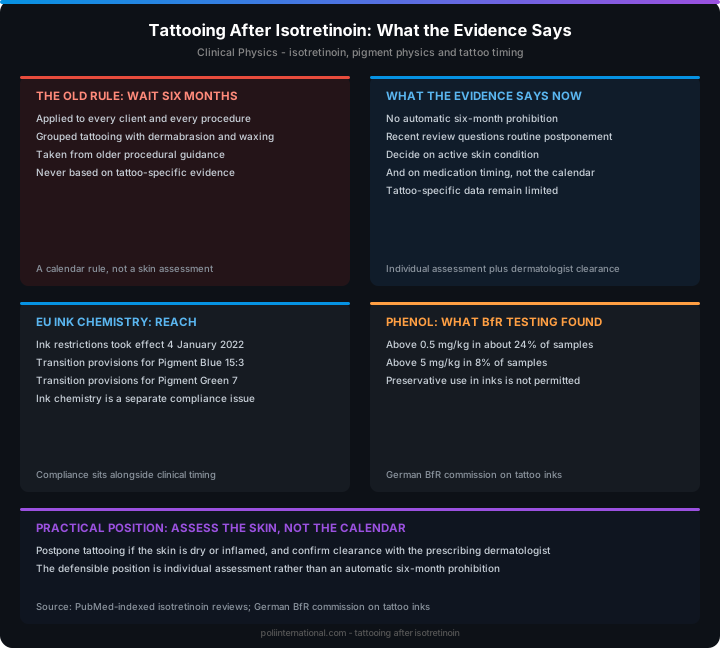
The traditional instruction to wait six months after isotretinoin came from older procedure guidance that grouped tattooing with aggressive resurfacing, dermabrasion, waxing, and some surgical procedures. More recent reviews have found that abnormal healing or scarring risk is minimal for many dermatological and surgical interventions during or soon after isotretinoin, although the evidence is not equally strong for every procedure or every patient.Examining the safety of dermatological and surgical procedures during or after isotretinoin therapy A clinical review has also reported that shorter intervals—around four weeks in some procedural contexts—may be reasonable rather than automatically requiring six months (Spring et al., Journal of Cosmetic Dermatology, 2023).
That does not make tattooing risk-free. Tattooing combines thousands of punctures with pigment deposition over a comparatively large area. A client with active cheilitis, fissuring, widespread peeling, eczema, a history of keloids, or a poorly controlled inflammatory skin condition is not equivalent to a client whose skin is clinically normal after treatment. The artist cannot determine the pharmacological risk from appearance alone, and the dermatologist cannot assess needle technique, pigment load, or studio conditions. The decision must therefore be shared rather than outsourced to a slogan.
This is why the relevant reader question is not simply “How long after Accutane can you get a tattoo?” It is “Is the skin currently able to tolerate controlled dermal injury, and has the prescribing clinician cleared the timing?” The same distinction applies when assessing how tattoo anatomy determines pigment placement and colour appearance in the skin: depth and tissue condition affect the result as much as the ink itself.
2. Pigment behaviour after deposition: colour is an optical and biological compromise
Pigment appearance depends on three interacting variables: particle distribution, optical absorption and scattering, and biological relocation. A tattoo does not remain a perfectly packed layer of particles. Some pigment is retained within dermal cells and matrix; some is transported through lymphatic and immune pathways; some is altered by light exposure or later laser treatment.
| Feature | Dark pigments, especially black | Light pigments, especially yellow, white, and pastel |
|---|---|---|
| Visible-light absorption | High absorption gives strong contrast and optical density | Greater reflection makes the colour more dependent on surrounding skin |
| Optical reserve | Usually remains legible after moderate fading | Small losses in concentration can produce a large visual change |
| UV sensitivity | Carbon-based dark pigments can remain visually dense despite surface fading | Organic and light-toned pigments may show obvious desaturation |
| Effect of dermal scattering | Can shift very deep deposits toward blue-grey | Can reduce saturation and make the colour appear chalky or muted |
| Practical correction | Control depth and avoid unnecessary trauma | Use conservative passes, appropriate saturation, and realistic fade counselling |
Small particles are more readily exposed to cellular transport and lymphatic handling, while larger agglomerates can increase opacity but may produce less uniform colour. A published Poli analysis places useful visible pigment distributions broadly in the tens-to-hundreds of nanometres, but a universal “ideal particle size” does not exist because pigment chemistry, dispersion, carrier fluid, concentration, and dermal location all matter.Optical physics, skin optics and pigment appearance
Yellow, white, and pastel colours fade faster in practical work for several overlapping reasons. They often have lower visual contrast against skin, their colour depends strongly on a relatively narrow absorption profile, and they contain less optical density than black. Once a modest amount of pigment is removed or redistributed, the eye notices the change more readily. That is different from claiming that every yellow particle is intrinsically unstable or that every white ink has the same chemistry.
Skin tone adds another optical filter. Melanin absorbs strongly in shorter wavelengths, particularly in the ultraviolet and blue region, while collagen scatters light through the dermis. As a result, blue and violet components can appear attenuated or altered in more highly pigmented skin, and deep deposits can develop a blue-green cast through the Tyndall effect. The practical response is not to “go deeper” indiscriminately. Excess depth increases trauma, widening, and blurred edges; it does not cancel optical scattering.
For artists, colour planning should therefore include the client’s baseline skin optics, the intended contrast after healing, and the pigment’s expected loss of saturation. A fresh, highly saturated pastel is not evidence that the healed result will retain the same visual strength.
3. Clinical timing, regulatory chemistry, and studio decisions
The most defensible current position is individual assessment rather than an automatic six-month prohibition. A recent PubMed-indexed review concludes that routine postponement solely because of current or recent isotretinoin may be unnecessary for many procedures, while also calling for more prospective data in darker skin phototypes and people predisposed to abnormal scarring.Examining the safety of dermatological and surgical procedures during or after isotretinoin therapy An experimental study likewise reported that isotretinoin did not slow wound healing and might support aspects of the growth phase, although experimental findings cannot establish safe tattoo timing for every client.Exploring isotretinoin's unexpected acceleration of wound healing
That evidence should change the conversation, not eliminate caution. Before booking or tattooing a client who is taking isotretinoin or stopped recently, document:
- The medication status: current use, stopping date, dose, and reason for treatment.
- The local skin condition: cracking, scaling, dermatitis, sunburn, infection, or active acne in the tattoo area.
- Personal and family history of keloids or hypertrophic scarring.
- Previous reaction to tattoos, pigment allergy, or delayed wound healing.
- The dermatologist’s view when timing is uncertain, the treatment is ongoing, or the client has significant skin disease.
The artist should not promise that pigment will heal normally simply because the client has reached six months. Nor should the artist tell every client that tattooing is safe immediately after stopping medication. The clinically useful action is to identify elevated uncertainty and obtain medical input.
Ink chemistry adds a separate compliance issue. In the European Union, REACH restrictions on tattoo inks took effect on 4 January 2022, with transition provisions for Pigment Blue 15:3 and Pigment Green 7. The German Federal Institute for Risk Assessment reports that tattoo inks contain colourants, dispersants, and additives such as polymers, pH regulators, defoamers, and preservatives, while restricted substances are subject to maximum concentration limits.Questions and answers about tattoo inks
Recent BfR commission material reports phenol above the legal limit of 0.5 mg/kg in approximately 24% of tested samples, with 8% above 5 mg/kg, and notes that preservatives functioning as preservatives are not permitted under the relevant framework.6th Meeting of the BfR Commission on Tattoo Inks That is not a reason to diagnose every preservative-containing ink as dangerous, but it is a reason to use traceable products, retain batch information, and understand the regulations in the jurisdiction where the studio operates.
The practical protocol is straightforward: inspect the skin, reduce unnecessary trauma, use documented compliant ink, avoid tattooing compromised tissue, and refer medication questions to the prescriber. Do not solve uncertainty with extra passes. The skin is not a printer that becomes more accurate when the operator presses harder.
4. Patrick's Note: The Price Race
THE PRICE RACE. The commercial cause behind a problem that looks technical.
A client on isotretinoin is often treated as a scheduling inconvenience: either apply the old six-month rule without thinking or squeeze the appointment through because the deposit is already paid. Both responses are shortcuts. The mechanical breakdown begins when a studio treats skin as a standardised substrate and every colour as if it carries the same biological and optical load.
The same price pressure appears in ink sourcing. Cheap, poorly documented batches and vague ingredient records create a technical problem downstream, where the artist is expected to compensate with more passes, more saturation, and more confidence than the material deserves. A better studio process is less dramatic: inspect, document, use compliant supplies, and refuse compromised skin. The chemistry and regulatory history of phenol in tattoo inks matters because traceability is cheaper than explaining an avoidable failure after the fact.
5. FAQ: Technical Q&A
Q: Is six months after Accutane a mandatory waiting period before a tattoo?
No universal evidence-based rule makes six months mandatory for every client and every procedure. Recent reviews question routine postponement solely because of isotretinoin, but tattoo-specific data remain limited, so current medication, skin condition, scarring history, and prescriber input should determine the decision.Examining the safety of dermatological and surgical procedures during or after isotretinoin therapy
Q: Why do yellow, white, and pastel tattoos fade faster than black?
They usually have less optical density and lower contrast against skin, so a smaller loss of pigment produces a larger visible change. Their appearance is also more affected by melanin absorption, dermal scattering, ultraviolet exposure, and the specific pigment chemistry.
Q: Should an artist tattoo deeper to make light colours last?
No. Excess depth increases tissue trauma, pigment spread, scarring risk, and blue-grey optical shift from dermal scattering. Light-colour longevity is better managed through suitable pigment selection, controlled deposition, realistic aftercare, and honest expectations.
Conclusion: Assess the Skin, Not the Calendar
A client who has recently used isotretinoin needs an individual risk assessment, not an automatic dismissal and not a casual clearance. Check the skin, ask about scarring and treatment status, obtain medical input when appropriate, and avoid tattooing compromised tissue.
Pigment longevity is governed by biology and optics: particle distribution, dermal depth, immune transport, melanin, scattering, and light exposure all matter. For a practical explanation of how tattoo pigment appearance changes with particle size, skin optics, and deposition depth, use the physics to set technique and expectations before the needle starts.