Shop
Clinical Physics

Exercise After a Tattoo? Gym & Swim

PP

Chief Engineer

Patrick Poli

Journal Date

2026-08-01

Last Reviewed

2026-10-13

How Soon After a Tattoo Can You Work Out?

Key Takeaways:

» A fresh tattoo is an open wound with no protective skin barrier for at least the first 48 hours
» Minimum waits: 24 to 48 hours for light walking, 3 to 5 days for yoga, 5 to 7 days for weightlifting and heavy cardio, 4 full weeks for swimming
» Working out too early can cause ink loss, patchy healing, and bacterial infection, any of which may require a costly touch-up or medical treatment
» Your tattoo is ready for the gym when the surface is dry and peeling, there is no tenderness to light touch, and all scabs have fallen off naturally
» Protect a healing tattoo during exercise by cleaning before and after, wearing loose cotton, using a towel barrier on shared equipment, and never wrapping the area
» If you see spreading redness, warmth, pus, or develop a fever, seek medical attention the same day; tattoo infections can escalate quickly
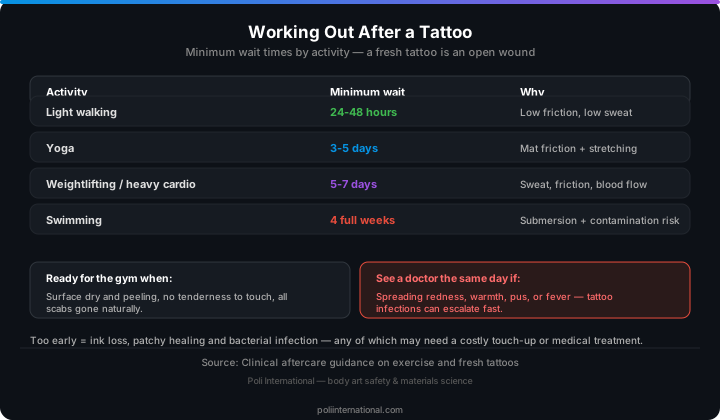
Working out after a tattoo: minimum wait times by activity from 24-48 hours for walking to 4 full weeks for swimming, with infection warning signs
Infographic: Working out after a tattoo: minimum wait times by activity from 24-48 hours for walking to 4 full weeks for swimming, with infection warning signs

1. Why Working Out Too Soon Risks Damaging a New Tattoo

A fresh tattoo is an open wound. The needle has created thousands of micro-punctures through the epidermis into the dermis, and the skin's protective barrier is gone for at least the first few days. During that window, three things from exercise can cause serious problems.

Sweat and bacteria. Sweat is mostly water and salt, but it carries skin bacteria, and gym equipment is a high-contact surface. A fresh tattoo has no barrier against staphylococci or pseudomonas entering through broken skin.

Friction and pressure. Compression tights, sports bras, bench-press contact, yoga-mat friction, and even repeated arm movement against your side abrade the healing surface.

Increased blood flow and swelling.

2. Minimum Wait Times by Workout Type

The wait time is not one number. It depends on tattoo size, placement, and the type of exercise.

Workout typeMinimum waitWhy
Light walking (outdoors)24-48 hoursLow sweat, minimal friction if clothing is loose. Avoid if the tattoo is on the leg, ankle, or foot where shoes rub
Yoga / Pilates / stretching3-5 daysMat contact is a hygiene risk; skin stretching during poses stresses wound edges. If the tattoo is on the back, hips, or shoulders, wait until peeling starts
Weightlifting (moderate)5-7 daysSkin stretching under load, shared equipment contact, and increased blood pressure can force plasma and ink out. Wait until the surface is dry and peeling has started
Running / HIIT / heavy cardio5-7 daysHeavy sweat, repetitive motion friction, and elevated body temperature create ideal conditions for bacterial growth. Leg, back, and chest tattoos are especially vulnerable
Contact sports / martial arts2-4 weeksDirect impact, mat burns, and shared skin contact. Wait until the tattoo is fully surfaced, no scabbing, no peeling, smooth to touch
Swimming (pool, sea, lake)4 weeks minimumSubmerging a fresh tattoo is the fastest way to cause a serious infection. Chlorine irritates healing tissue; lake and seawater carry pseudomonas and vibrio species

Swimming is the highest-risk activity. Even a healed-over tattoo is not waterproof: the surface may look closed by week three, but the dermis beneath is still remodelling for four to six weeks. Submersion before four weeks carries a real risk of bacterial entry, and waterborne tattoo infections tend to be more aggressive than surface-contact ones. See our swimming after tattoo and piercing safety guide for the full breakdown.

3. What Happens If You Work Out Too Early

Mild: prolonged redness and oozing. It typically resolves with rest and proper aftercare, but it delays the peeling stage by a week or more.

Moderate: ink loss and patchiness. Ink particles are pulled out with plasma before the fibroblasts can anchor them, leaving light patches, blurred lines, and uneven saturation that do not self-correct. A touch-up session is required once the skin has fully healed, typically six to eight weeks later, at additional cost and time.

Severe: bacterial infection. Staphylococcus aureus and Streptococcus pyogenes are the most common culprits from gym-acquired tattoo infections. Signs include spreading redness beyond the tattoo border, warmth, pus, and systemic symptoms like fever. These infections require antibiotics, and the cosmetic damage is often permanent even after the infection clears.

If redness spreads more than 1 cm beyond the tattoo border, the area is hot to touch, or you develop a fever, go to a clinic or A&E the same day. Tattoo infections can progress to cellulitis or sepsis within 48 hours if the organism is aggressive. Our guide on when a tattoo turns into sepsis explains which symptoms warrant an emergency visit.

4. Signs Your Tattoo Is Ready for the Gym

The surface is dry and peeling has started. The tattoo feels like sunburned skin, not an open cut, and peeling means the epidermis is regenerating underneath.

No tenderness to light touch. Press gently with a clean fingertip. If it still feels tender or bruised, the dermis is not ready for mechanical stress. Wait another two to three days and check again.

No scabs or cracks. Thick scabs mean the wound is still sealing. Movement can crack a scab open, restarting the healing clock from zero. Wait until all scabs have fallen off naturally. If you are tempted to help them along, read what happens when you pick the scab off a healing tattoo first.

5. How to Protect a Healing Tattoo During Exercise

Clean the area before and after.

Wear loose, breathable clothing. Cotton beats synthetic compression fabrics for the first few weeks. Avoid seams that sit directly on the tattoo, and if the tattoo is on your back, wear a fresh loose cotton shirt rather than re-wearing one mid-session.

Use a barrier on shared equipment. Lay a clean towel on benches, mats, and machine seats, and wipe equipment down before use even if the last person did.

Avoid the sauna and steam room. Heat and humidity accelerate bacterial growth; a sauna session is functionally equivalent to submerging the tattoo in warm water. Wait until the tattoo is fully surfaced, typically four weeks.

Do not wrap the tattoo. Wrapping a healing tattoo before exercise traps sweat and bacteria against the wound, creating exactly the warm, moist environment pathogens need. Let the tattoo breathe.


From the Chief Engineer's Workbench

Patrick Poli · 25+ years in body-jewellery manufacturing

Patrick's Deep Archive

In my years working with instrument-grade materials and skin contacts, I have learned that the body treats a tattoo exactly like our manufacturing process treats a coated component: the surface must stabilise before it takes load. In our facility, a coated part is never handled, tested, or shipped until the coating has cured and been verified. Pull it out of the line early and you get adhesion failures that no amount of rework can fully reverse.

A tattoo is a coated surface, and the coating is your new skin. The gym is the load test. I have seen clients lose significant work because they treated the minimum wait as a suggestion: a full-back piece gone patchy from a bench-press session on day four, a thigh piece infected from a spin class on day six. The people who healed perfectly never counted hours; they watched the skin itself. Dry, peeling, no tenderness, no scabs. That is the quality gate. Respect it the way you would respect a spec sheet.

PPPatrick PoliChief Engineer · Creator of BioFlex® body jewelry

7. FAQ

Can I do light cardio like an exercise bike the day after a tattoo?

Not recommended. A fresh tattoo still has no epidermal barrier. Wait at least 48 hours, and five days if the tattoo is on the thigh, glute, or lower back.

What if I have a competition and cannot skip training?

Minimise the risk: cover the tattoo with clean, loose cotton, clean it with antimicrobial soap immediately after the session, and avoid exercise that puts direct pressure or friction on the area. Accept that healing may take longer and the result may need a touch-up. It is a trade-off with consequences, not a free pass.

Does a small tattoo heal faster for working out?

Can I wear a compression sleeve over a healing arm tattoo?

I worked out too early and my tattoo looks faded in spots. Will it fix itself?

No. Ink loss from premature exercise is permanent. The skin will heal over, but the missing pigment will not return. You will need a touch-up session once the area is fully healed, typically at six to eight weeks, scheduled only after the skin has fully settled.

Conclusion

A fresh tattoo is an open wound, and the gym is one of the most hostile environments you can expose it to in the first weeks. The minimum waits exist for a reason: 24 to 48 hours for light walking, 3 to 5 days for yoga, 5 to 7 days for weightlifting and cardio, and 4 full weeks before any water submersion. Wait for the three readiness signs, dry and peeling, no tenderness, no scabs, then ease back in with loose clothing, strict cleaning, and towel barriers on equipment. If you train too early, you risk ink loss and infection that no amount of aftercare can undo. The gym will still be there in a week; your tattoo will not re-heal.

6. Realistic Timelines for Your First Sweat Session

Let's cut through the guesswork. The most common question I get, both from clients and at the gym when someone spots a fresh piece, is "when can I actually get back to training without wrecking this tattoo?" The truth is, there's no one-size-fits-all answer because it depends on the activity, the tattoo's location, and how well you've been caring for it. But here's a practical framework based on 25 years of working with body art and the biophysics of healing skin.

First 48 hours: critical no-sweat window. Your tattoo is an open wound with no protective barrier. Sweat contains bacteria that can easily penetrate the wound and cause infection. Walking is fine if you keep it light, no pushing a pace that gets you sweating. But anything that raises your heart rate significantly or causes friction against the tattoo is a hard no.

Days 3 to 5: low-impact only. Yoga, stretching, or light cycling are generally okay if the tattoo is in a spot that doesn't rub against clothing or equipment. But if you're doing anything that bends or twists the skin around heavily shaded areas, like a back piece or a knee piece, those skin folds can crack the healing tissue and pull out ink. I've seen more blowouts from a single yoga class than from a month of poor aftercare.

Days 5 to 7: back to strength training. This is when the surface has closed over enough to handle the friction of a shirt and the pressure of a barbell. But you still need to be smart: keep the tattoo clean before and after, avoid exercises that directly engage the tattooed area (no bicep curls if it's on your arm), and wash with antibacterial soap immediately after your session.

Full 4 weeks for swimming. Pools, oceans, lakes, any body of water is a bacterial buffet. Even if your tattoo looks healed by day 10, the deeper layers are still mending. One dip too early can turn a crisp design into a faded mess or worse, a skin infection.

But here's the kicker: healing isn't just about time, it's about the quality of your skin's recovery. That's why I created BioFlex® body jewelry from medical-grade PP-R polymer. It's non-reactive, hypoallergenic, and won't trap sweat against the skin like metal can. If you've got piercings that are also healing, switching to BioFlex® during your training phase reduces irritation and risk of infection.

Listen to your body, and your tattoo. Redness, puffiness, or a hot sensation around the ink means you're pushing too hard. If the area feels tight or itchy, it's still healing. Give it a few more days. The gym will still be there; your tattoo's quality won't be negotiable.

If you want to track your healing against a safe routine, check out our healing timeline tool or grab a set of BioFlex® retainers to keep piercings safe during workouts.

6. Why the First 48 Hours Are Non-Negotiable

Every time someone asks me, 'can I exercise after a tattoo?', the answer is always the same: not if you want it to heal right. I've been making BioFlex® body jewellery for 25 years, and I've seen what happens when people hit the gym too soon. A fresh tattoo is an open wound. Your body is literally rebuilding the skin barrier, and anything that raises your heart rate, increases blood flow, or causes friction around the area is going to compromise that process.

Blood pressure spikes from lifting, sweating under a sleeve, or rubbing against a bench, all of it can push ink out, cause scabbing, or invite infection. That's why I stress the 48-hour rule. If you're thinking 'how long after a tattoo can I workout?', the bare minimum for any kind of gym session is 5 to 7 days. Heavier lifting or high-intensity cardio? Pushing it to 7 days is safer. Swimming? That's 4 full weeks, because pools, lakes, and oceans are bacteria soup, and your tattoo is a doorway.

The real key is listening to your body. After 48 hours, you might feel fine, but your skin isn't. Look for complete closure, no weeping, no raised edges, no redness beyond the ink. If it still feels tight or leaks plasma, you're not ready. I've seen people lose half a tattoo because they couldn't wait a week. Don't be that person.

So, here's my direct advice: treat the first 48 hours as absolute rest. Days 3 to 5, do light walking if you must. Day 5 to 7, you can start low-impact work like bodyweight or light weights, but keep the area clean and dry. And if you're a swimmer, give it a full month. Your tattoo will thank you.

Want to know how to protect your healing piercing or tattoo during workouts? Check out our BioFlex® jewellery collection, or use our sizing tool to get the right fit. You can also read our guide on safe body art aftercare for more expert tips.

Remember, I've spent decades perfecting materials that are biocompatible and safe for your skin. Your training can wait a few days, but a bad infection can ruin your ink and your health. Train smart, heal right.

6. Exact Timelines for Your First Workout Back

Let’s cut through the guesswork. If you’re asking “after a tattoo when can I exercise?”, here’s the straight answer based on how wounds heal and what actually prevents infection. Your tattoo is an open wound, and sweat, friction, and gym bacteria are the three enemies. For light walking, you can start within 24 to 48 hours, just keep the area clean and don’t let clothing rub. For yoga (especially anything that stretches the tattooed area), wait 3 to 5 days, and avoid hot yoga entirely until the peeling stage is done. Weightlifting and heavy cardio? Hold off for 5 to 7 days. I’ve seen too many people ruin fresh ink by doing deadlifts on day three, the micro-tears in the skin and the grime on gym equipment are a recipe for infection. Swimming is a hard no for 4 full weeks, because pool chemicals and lake bacteria can penetrate the healing barrier long after the surface looks closed.

Now, what about the question I get most: “can I exercise after a tattoo if I cover it with a bandage?” No. A standard bandage doesn’t seal out sweat or bacteria, and trapping moisture against a fresh tattoo creates the perfect breeding ground for infection. If you absolutely must work out before day five, use a sterile, breathable film dressing, change it immediately after, and clean the area gently. But honestly, the best move is to plan your gym sessions around your tattoo appointment, not the other way around. I’ve been fitting body jewellery for over 25 years, and I’ve seen every consequence of rushing back to the gym, from mild irritation to full-blown staph infections that permanently scar the design. Your tattoo is an investment. Treat it with the same care you’d give any open wound.

If you’re already thinking about your next piercing or need aftercare advice that won’t compromise your healing, check out our BioFlex® body jewellery collection, designed for sensitive skin and safe even during workouts once fully healed. And for more post-procedure guidance, read our article on piercing aftercare and exercise.

6. How Soon After a Tattoo Can You Work Out? Gym, Running, and Swimming Timelines

Most people asking "can I exercise after a tattoo" are really asking three different questions: when can I lift, when can I run, and when can I get back in the pool. The answers are not the same, and none of them is "whenever it stops hurting." A fresh tattoo is an open wound with no protective skin barrier for at least the first 48 hours, and that barrier matters more than how the tattoo looks on the surface.

For light walking, 24 to 48 hours is reasonable if you keep it clean and avoid friction. For yoga, 3 to 5 days. For weightlifting and heavy cardio, 5 to 7 days is the realistic minimum. For swimming, 4 full weeks. Chlorine and bacteria in pool water are not worth the risk before the skin has fully closed, and a soak in a bath is the same problem. Sweat itself is not the enemy; the enemy is grinding a fresh wound against equipment, clothing, or another person's skin while it is still healing.

I have been making BioFlex® body jewellery for 25 years, and the same principle applies to piercings that applies to tattoos: the first week decides how the site heals. With a new piercing, movement and friction do more damage than sweat. If you train with a fresh piercing, secure it, keep it clean, and do not let it catch on bars, straps, or a partner. That is why BioFlex® PP-R polymer is used for mouth, eyebrow, and cartilage piercings where metal and movement do not mix well. It is a medical-grade plastic, ISO 10993 and USP Class VI, and people wear it for years without issue. It is not a short-term tool, and anyone who tells you only titanium works for fresh piercings is repeating a myth.

If you are unsure whether your routine is safe, read our guide to aftercare and infection signs before you go back. Then check the tools page to plan your return to training without setbacks.

Mind map · Exercise After a Tattoo? Gym & Swim

  • Post-Tattoo Exercise Safety
    • Workout Rest Timelines

      Nickolai Stausland recommends a complete forty-eight hour rest followed by light training away from the tattoo starting on day three.

      • Forty Eight Hour Rest
      • Light Active Recovery
      • Full Training Return
    • Infection and Healing Warnings

      Gym surfaces harbor dangerous bacteria like staphylococcus aureus and staph that can enter open wounds and cause serious skin infections.

      • Gym Surface Bacteria
      • Open Wound Exposure
    • Ink Preservation Methods

      Sweat containing sodium and urea can soften healing skin and pull ink particles out of the dermis before pigment stabilization.

      • Sweat and Salt Softening
      • Friction and Scab Damage
      • Skin Stretching Blowouts
    • Piercing Workout Safety Guidelines

      Earlobe piercings require twenty-four to forty-eight hours of rest, whereas navel piercings need up to four weeks before intense exercise.

      • Earlobe Wait Times
      • Navel Wait Times
StructureProcessMaterialHazard

4 branches, 0 sources. Each branch cites the article it came from; the labels beneath it are names, not claims.

Tattoo Aftercare Quiz

  1. 1. What is the minimum recommended wait time before resuming swimming in a pool, sea, or lake after getting a new tattoo?

    • • 5 to 7 days — While 5 to 7 days is sufficient for resuming weightlifting or heavy cardio, it is inadequate for full water submersion.
    • • 2 weeks — Even if the skin surface appears closed at two weeks, the underlying dermis remains vulnerable to waterborne bacteria.
    • • 3 weeks — Surface regeneration may look complete by week three, but deeper dermal remodeling requires additional healing time before safe submersion.
    • ✓ 4 weeks — A full four weeks allows the dermis beneath the surface to complete essential remodeling and establish a complete barrier against aquatic pathogens.
  2. 2. Which specific bacterial species are identified as the most common culprits in gym-acquired tattoo infections?

    • • Pseudomonas aeruginosa and Vibrio vulnificus — These species are predominantly associated with exposure to natural water bodies and pools rather than typical gym surface contacts.
    • ✓ Staphylococcus aureus and Streptococcus pyogenes — These bacteria commonly reside on human skin and high-contact equipment surfaces, making them the primary source of gym-acquired skin infections.
    • • Escherichia coli and Clostridium tetani — These organisms are associated with enteric contamination or deep puncture wounds rather than standard gym surface cross-contamination.
    • • Mycobacterium marinum and Legionella pneumophila — These pathogens are tied to aquatic environments or aerosolized water systems rather than equipment contact in fitness facilities.
  3. 3. Why is wrapping a fresh tattoo in plastic or non-breathable bandages during a workout explicitly discouraged?

    • • It restricts blood flow needed to supply ink particles to the dermis. — Wrapping does not significantly restrict systemic vascular flow, but it drastically impacts local moisture and microbial levels.
    • ✓ It traps sweat and bacteria against open skin, creating a warm, moist environment for pathogens. — Enclosing fresh micro-punctures under heat and sweat creates ideal incubation conditions for aggressive bacterial growth.
    • • It causes immediate chemical breakdown of tattoo pigment under pressure. — Tattoo pigments are chemically stable compounds that do not break down from simple mechanical compression.
    • • It prevents plasma from leaking out, which leads to thick scab formation. — Thick scabs typically form from drying plasma when exposure to open air is unmanaged, rather than from trapped fluid under film.
  4. 4. Which clinical sign indicates that a client should seek same-day medical attention at a clinic or emergency facility?

    • • Mild surface peeling and localized itching around day four post-procedure. — Peeling and light itching are normal physiological markers of epidermal regeneration.
    • • Clear plasma weeping during the initial 24 hours after tattooing. — Initial plasma exude is a standard inflammatory response following dermal puncture.
    • ✓ Redness spreading more than 1 cm beyond the tattoo border accompanied by warmth or fever. — Expanding erythema beyond the wound edge combined with localized heat or systemic fever indicates a rapidly progressing bacterial infection.
    • • Dry flaking skin transferring small amounts of pigment onto loose clothing. — Exfoliation of superficial epidermal skin cells containing residual pigment is expected during normal healing.
  5. 5. What combination of physical indicators signals that a tattoo is ready to withstand gym exercise?

    • • The surface skin appears shiny and smooth after 48 hours. — A shiny surface within 48 hours usually indicates active weeping or fresh thin scabbing rather than complete structural healing.
    • ✓ The tattoo is dry and peeling, free of scabs, and exhibits no tenderness to light touch. — These indicators confirm that the protective epidermal barrier has reformed and the underlying dermis is no longer inflamed or vulnerable to mechanical stress.
    • • Thick scabs have fully covered all saturated color areas. — Thick scabs indicate that the wound underlying the area is still open and prone to cracking under physical strain.
    • • Plasma oozing has transitioned from cloudy fluid to clear fluid during exertion. — Any ongoing oozing during physical effort demonstrates that the wound barrier remains open and unfit for gym environments.
  6. 6. If ink pigment is pulled out with plasma due to early exertion, what is the long-term outcome for the tattoo?

    • • The missing pigment gradually migrates back into the dermis over three to four months. — Dermal macrophages cannot regenerate or redistribute lost pigment once it has been purged from the skin.
    • • The area self-corrects once epidermal peeling finishes completely. — Epidermal regeneration only heals the top skin layer, leaving lower-level ink voids uncorrected.
    • ✓ Ink loss leaves permanent light patches or blurred lines that require a touch-up session after full healing. — Once ink particles are displaced before fibroblast anchoring occurs, the resulting voids are permanent until professionally repigmented.
    • • The skin compensates by producing elevated melanin levels over the faded spots. — Melanin production is a response to ultraviolet radiation and does not match or replace lost tattoo ink.
  7. 7. How long should a client wait before participating in yoga, Pilates, or stretching routines after getting a tattoo?

    • • 24 to 48 hours — This short timeframe is only appropriate for low-sweat activities like light walking.
    • ✓ 3 to 5 days — A three-to-five-day rest period prevents excessive skin stretching across wound edges and lowers infection risks from shared equipment mats.
    • • 7 to 10 days — Waiting up to ten days exceeds the requirement for low-impact stretching unless severe complications have occurred.
    • • 4 weeks — A four-week wait is specifically designated for complete water submersion rather than low-impact flexibility training.
  8. 8. Why are saunas and steam rooms considered functionally equivalent to submerging a healing tattoo in water?

    • • High atmospheric humidity dissolves the protective skin oil barrier permanently. — Humidity temporarily alters surface moisture, but the primary hazard stems from heat and microbial acceleration on open tissue.
    • ✓ Elevated heat and moisture accelerate bacterial growth and trap condensation on unsealed tissue. — The ambient heat and high humidity simulate warm water submersion, fostering intense bacterial proliferation on healing wounds.
    • • Steam forces deep vascular dilation that washes all newly set ink into the bloodstream. — Increased blood flow can cause swelling and plasma release, but it does not flush dermal ink into circulation.
    • • Extreme temperatures cause immediate scarring of regenerating epidermal cells. — Thermal air exposure in standard saunas does not cause direct burn scarring, but it severely compromises wound hygiene.
  9. 9. Which clothing choice provides the safest protection for a healing tattoo during light physical activity?

    • • Synthetic compression wear to restrict skin elasticity around the wound. — Compression fabrics create significant friction and trap moisture directly against the compromised barrier.
    • ✓ Loose, breathable cotton garments that avoid tight seams on the tattooed area. — Loose cotton minimizes mechanical friction while allowing adequate airflow to keep the wound dry.
    • • Waterproof neoprene sleeves to insulate the tattoo from atmospheric bacteria. — Neoprene seals in heat and sweat, accelerating bacterial growth on the healing tissue.
    • • Tight nylon activewear to pull sweat away from the body rapidly. — Tight nylon creates repetitive friction across tender skin and can tear developing epidermal structures.
  10. 10. What underlying physiological condition makes the first 48 hours post-tattoo a strict no-sweat window?

    • • Sweat interacts chemically with tattoo pigments, altering their color fastness. — Sweat consists mainly of water and salts, which do not alter pigment chemistry.
    • ✓ Thousands of micro-punctures extend into the dermis, leaving open tissue without an epidermal barrier. — Because the epidermal layer has been perforated, skin bacteria carried by sweat can freely penetrate deep tissue layers.
    • • Elevated body temperature prevents dermal fibroblasts from forming. — Fibroblast activity is part of the inflammatory response and is not halted by temporary heat increases.
    • • Plasma production halts permanently if arterial pressure spikes during this timeframe. — Spiking blood pressure increases plasma exude rather than stopping it completely.
  11. 11. What is the minimum recommended wait time before returning to moderate weightlifting or heavy cardio?

    • • 24 to 48 hours — This short period is restricted to light walking, as blood pressure spikes from lifting can force out plasma and ink.
    • • 3 to 5 days — This range is intended for low-impact work like stretching or yoga, not intense strength training or heavy cardiovascular exertion.
    • ✓ 5 to 7 days — Waiting five to seven days gives the skin surface time to dry and begin peeling, reducing risks from blood pressure spikes and heavy sweat.
    • • 2 to 4 weeks — This extended timeline is reserved for high-impact contact sports or martial arts rather than standard weightlifting.
  12. 12. Why is natural open-water swimming in lakes or oceans particularly hazardous for a fresh tattoo?

    • • Natural salt concentrations immediately dissolve non-bound dermal ink. — Salinity does not dissolve dermal ink, though submersion causes significant biological contamination hazards.
    • ✓ Submersion exposes unsealed dermis to aggressive waterborne pathogens like Pseudomonas and Vibrio species. — Natural water sources harbour virulent bacteria capable of invading open wounds and causing severe deeper infections.
    • • Water pressure forces micro-scabs deep into the subcutaneous fat layer. — Hydrostatic pressure from swimming is far too low to drive surface debris into deep tissues.
    • • Natural water temperatures prevent the blood from clotting over epidermal punctures. — Clotting occurs during the initial hours post-procedure, long before swimming should ever be considered.

Extended Reference Table

8 of 8 rows

Extended reference table generated from the article and its verified research sources. Bracketed numbers jump to the matching entry in the Technical References below.

SafetyItem, Practice, or Standard Recommended Wait Time Safety Guidelines and Precautions Compliance or Specification Standards Source
✅Wound healing (biological phases of recovery)4 to 6 weeksTattoos result in open skin, making the body vulnerable to infection until the wound is fully closed.NCBI Bookshelf NBK470443
✅BioFlex body jewelry (PP-R polymer)During training phaseSwitch to these retainers to reduce irritation and infection risk as they are non-reactive and hypoallergenic.Medical-grade PP-R polymer
✅Swimming or Submerging in Water (Pools, Oceans, Lakes)2 to 4 weeksHighest risk activity; submersion causes aggressive bacterial infections (vibrio, pseudomonas) and ink pulling. Chlorine/salt irritate healing skin.-
✅Contact Sports or Martial Arts (BJJ, MMA, Rugby)2 to 4 weeksSkip during active healing to prevent bacterial transfer (MRSA, Staph, ringworm) and physical trauma/impact damage.CDC (2020) regarding MRSA/Staph prevention
✅High-intensity Exercise (HIIT, CrossFit, Heavy Cardio)7 to 10 daysAvoid drenching sweat which softens skin and draws out ink; prevent contact with bacteria-heavy gym mats and equipment.-
✅Weightlifting and Strength Training5 to 10 daysUse a towel barrier on shared equipment. Avoid movements that tax or stretch the tattooed area (e.g., deadlifts for back tattoos).-
✅Yoga, Pilates, or Stretching3 to 14 daysAvoid skin stretching that stresses wound edges or causes "blowouts." Avoid mat contact and hot yoga until peeling is complete.-
✅Navel Piercing (Exercise restrictions)1 to 4 weeks1-2 weeks for light exercise; 3-4 weeks for intense exercise. Avoid abdominal-focused movements and tight clothing.-

Free Body Art Wall Posters

Print-ready reference posters for your studio or your own wall. Free to download and display, embed on your own site with attribution. Click any poster to preview it full size before downloading.

Choose and download all 41 posters

Technical_References_Archive

About the Author

PP

Patrick Poli

Chief Engineer, Poli International · Creator of BioFlex® body jewelry

Patrick has spent 25+ years manufacturing body jewellery and studio equipment, and is the creator of BioFlex® body jewelry. He created the push-fit system so jewellery separates on impact instead of tearing the piercing. He also designed the flexible belly bar that lets a navel piercing stay in place through a pregnancy.

More about Patrick →

Last reviewed: 2026-10-13 · Published: 2026-08-01

Continue Reading