ECHA's 36th Update Added Two Substances, One of Them a First for the Candidate List
Key Takeaways:
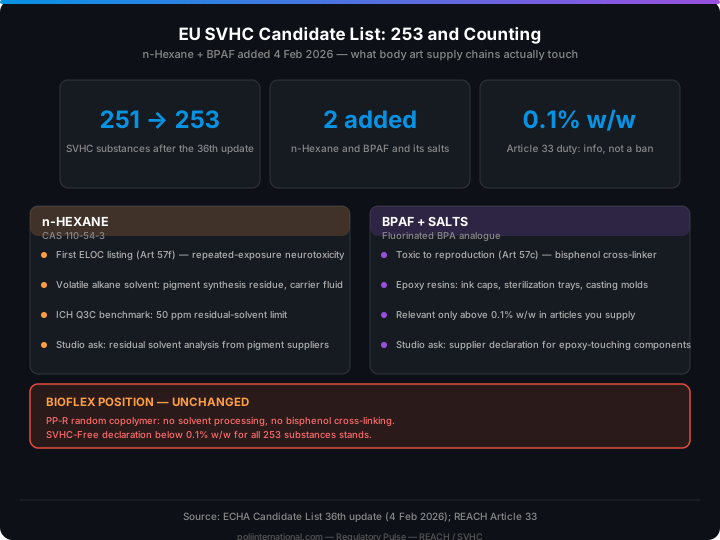
» On February 4, 2026, ECHA added 2 new substances to the REACH SVHC Candidate List, taking the total from 251 to 253.
» n-Hexane (CAS 110-54-3) is the first substance ever listed on the basis of equivalent level of concern (ELOC) - repeated-exposure neurotoxicity - rather than an intrinsic hazard class.
» BPAF and its salts (4,4'-[2,2,2-trifluoro-1-(trifluoromethyl)ethylidene]diphenol) are a fluorinated bisphenol A analogue classified as toxic to reproduction (Article 57c).
» For body art supply chains the exposure is narrow: n-hexane is a residual solvent from pigment synthesis and carrier fluids; BPAF appears in epoxy resins used in ink bottle caps, sterilization container components and jewelry casting molds.
» BioFlex PP-R random copolymer does not use either substance - no solvent processing, no bisphenol cross-linking - so the SVHC-Free declaration at <1 ppm remains valid.
» Article 33 duties activate only above 0.1% w/w in an article, and only when a consumer requests safety information.
1. What the February 4, 2026 Update Actually Added
ECHA's 36th update to the Candidate List of Substances of Very High Concern was published on February 4, 2026. Two substances were added and none removed, moving the list from 251 to 253 entries.
The headline addition is n-Hexane. It is the first substance to be listed under the equivalent level of concern (ELOC) route (Article 57f), a pathway that allows ECHA to act on substances with serious effects - here repeated-exposure neurotoxicity - even when they do not meet the formal classification criteria for a hazard class such as CMR. n-Hexane is a volatile alkane solvent, familiar in industrial degreasing, polymer processing and as a carrier in pigment synthesis. Its listing signals that ECHA will use the ELOC route more aggressively for substances with strong evidence of neurotoxicity.
The second addition is BPAF and its salts (4,4'-[2,2,2-trifluoro-1-(trifluoromethyl)ethylidene]diphenol), a fluorinated analogue of bisphenol A. It is classified as toxic for reproduction (Article 57c) and is used as a cross-linking agent and process regulator in epoxy resins, specialty plastics and precision-molded components.
2. What This Means for Body Art Supply Chains
Neither substance is a headline risk for studios, but both touch the supply chain in specific places.
n-Hexane matters as a manufacturing residue. It is used in pigment synthesis and carrier fluid formulation, and as a cleaning agent in jewelry production. It will not appear on a finished ink label, because it is not an ingredient - it is a residual from processing. The question for a studio is whether a pigment or carrier supplier used n-hexane in synthesis or purification and left residual concentrations. ICH Q3C pharmaceutical guidelines set n-hexane limits at 50 ppm, which gives a practical benchmark for requesting residual solvent analysis from suppliers.
BPAF matters through epoxy chemistry. It can appear in epoxy-based sterilization container components, precision-molded plastic caps on ink bottles, and specialty jewelry casting molds where residual epoxy contacts the finished metal. Any supplier using BPAF-containing epoxy in production, or any ink packaging containing BPAF polymer components, triggers the Article 33 information duty if the concentration exceeds 0.1% w/w.
3. The BioFlex Position: Why the Declaration Stands
BioFlex is a polypropylene random copolymer (PP-R) produced by Ziegler-Natta polymerization. The two new substances do not enter that chemistry:
- n-Hexane is a solvent used in resin formulation and cleaning. BioFlex uses finished medical-grade PP-R resin with no solvent residues.
- BPAF is a bisphenol-based cross-linking agent. PP-R is polymerized catalytically, not cross-linked through bisphenol chemistry.
The automated SVHC Monitor flagged both substances under the jewellery_polymer category because of keyword matching. That is a precautionary classification, not a chemistry finding. The conclusion after review: both are effectively false positives for PP-R, and BioFlex remains below 0.1% w/w for all 253 listed substances. The SVHC-Free declaration does not change.
4. What Studios Should Do
The practical checklist for a body art business after the February 2026 update:
1. Ask for residual solvent data from pigment and ink suppliers - specifically whether n-hexane was used in synthesis and what the residual concentration is. The 50 ppm pharmaceutical benchmark is a reasonable reference.
2. Check epoxy-touching articles: ink bottle caps, sterilization trays and containers, casting molds. Request a declaration from suppliers that BPAF is not present above 0.1% w/w.
3. Update supplier declaration files to the current 253-substance list so an audit or consumer request can be answered within the 45-day Article 33 window.
4. Do not over-react: the update adds duties, not bans. Listing on the Candidate List is the first step in a long authorization pipeline (typically 18-24 months), and the immediate obligation is information, not substitution.
5. FAQ
Does the February 2026 SVHC update ban anything?
No. Adding a substance to the Candidate List does not ban it. It creates communication and notification duties under Article 33 (respond to consumer requests within 45 days) and supply-chain information duties under Article 31/32. Full restriction or authorization requirements come later in the regulatory pipeline.
What is n-hexane and why is its listing unusual?
n-Hexane is a volatile alkane solvent used in industrial degreasing and pigment synthesis. Its listing is the first under the equivalent level of concern (ELOC) route - ECHA used strong evidence of repeated-exposure neurotoxicity rather than a formal hazard classification.
Could n-hexane or BPAF be in my tattoo ink or jewelry?
n-Hexane is a possible residual in pigment synthesis (ask suppliers for residual solvent analysis); BPAF is possible in epoxy components of packaging or casting molds. Neither is a direct ingredient of ink or jewelry alloys.
Is BioFlex affected by the two new substances?
No. BioFlex is PP-R random copolymer produced by Ziegler-Natta polymerization. It does not use n-hexane solvent processing or bisphenol cross-linking chemistry, so it remains below 0.1% w/w for all 253 SVHCs.
When is the next SVHC update expected?
ECHA updates the Candidate List roughly twice per year, typically around January and June/July. The next update after February 2026 was expected in mid-2026; the REACH Monitor tracks each published change.
Conclusion
The February 4, 2026 SVHC update adds real regulatory surface area - n-hexane as the first ELOC-based listing and BPAF as another bisphenol under scrutiny - but for body art professionals the practical impact is narrow and manageable. Ask for residual solvent data, check epoxy-touching packaging and molds, and keep supplier declarations current against the 253-substance list. The BioFlex position is unchanged: below 0.1% w/w for every listed substance, declaration intact.