Shop
Body Art News

Finger Piercings Are Trending. The Hand Is Not a Piercing Site.

PP

Chief Engineer

Patrick Poli

Journal Date

2026-10-08

Last Reviewed

2026-10-09

If the jewellery sits in the back of your hand, the problem is not whether it looks good—it is whether the anatomy can keep it there.

Key Takeaways:
» Finger and hand piercings are being promoted as a celebrity-linked social-media trend, but professionals warn that the location is poorly suited to stable healing.
» The skin over the hand is thin, highly mobile, and repeatedly exposed to friction, impact, washing, and snagging.
» A piercing can appear healed on the surface while the deeper channel is still inflamed or migrating.
» Jewellery that moves, catches, sinks, or leaves increasingly thin skin should be assessed promptly by a qualified piercer or clinician.
» Viral visibility is not anatomical evidence: a trend can be popular and still be a bad procedure.

1. The Trend Is Real. The Anatomy Is Unimpressed.

The latest body-art story making the rounds is the finger piercing: jewellery placed through the back of a finger or hand, often presented online as an edgy alternative to conventional hand jewellery. French coverage published on October 7 described the trend as having been amplified by social-media celebrity imagery, including appearances associated with North West, while a viral TikTok from Minerva Piercing Lyon warned viewers about the practice’s risks.Paris-Normandie’s report on the hand-piercing trend

That warning is not pearl-clutching. It is basic mechanical anatomy. The back of the hand and fingers are constantly moving over tendons, joints, and thin soft tissue. They are also among the first places to meet doorframes, pockets, tools, phones, countertops, clothing, and the small humiliations of daily life. A piercing is a controlled wound that needs relative stability. The hand is a moving platform with a collision problem.

A piercing channel heals by forming new tissue around the jewellery. That process depends on limiting repeated shear—the sideways force created when the jewellery is pushed, pulled, or levered. A finger piercing receives that force every time the joint bends or the jewellery catches. The tissue is not merely healing; it is being asked to build a stable tunnel while the floor keeps moving.

2. Why the Hand Loses the Argument

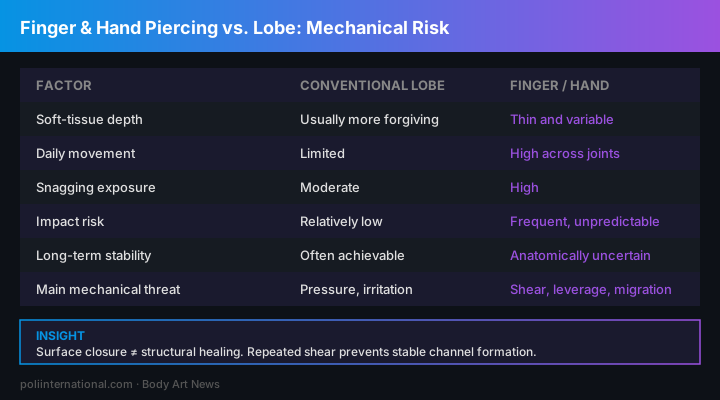
The critical distinction is between surface closure and structural healing. A piercing may stop bleeding, lose its initial swelling, and look tidy in photographs while the channel remains vulnerable underneath. If the jewellery is repeatedly displaced, the body can respond with persistent inflammation, excess granulation tissue, migration, or rejection.

FactorConventional lobe piercingFinger or hand piercing
Soft-tissue depthUsually more forgivingOften thin and variable
Daily movementLimitedHigh, especially across joints
Snagging exposureModerateHigh
Impact riskRelatively lowFrequent and unpredictable
Long-term stabilityOften achievableAnatomically uncertain
Main mechanical threatPressure and irritationShear, leverage, and migration

The hand also has a poor relationship with contamination. That does not mean every touch causes infection; it means the site is difficult to protect. Hands contact public surfaces, personal devices, cleaning products, food, sweat, and water throughout the day. The relevant risk is not a dramatic cinematic infection arriving on schedule. It is the accumulation of irritation and contamination around a wound that is already being mechanically disturbed.

That is why a client asking whether a finger piercing is “healing normally” needs more than a photograph-based answer. Increasing redness, heat, swelling, throbbing pain, pus, red streaking, fever, or loss of movement are not decorative features. They require medical assessment. A qualified piercer can identify migration and pressure problems, but suspected spreading infection belongs with a clinician.

3. The Engineering Problem: Jewellery Is a Lever

The jewellery itself is not passive. Any piece protruding from thin tissue becomes a lever arm. The farther it extends from the skin, the more force is transferred to the channel when it catches. In simple terms, torque increases with the distance between the point of force and the tissue. A ring, bar, or decorative end can therefore magnify a minor snag into a significant pull.

This is why “it only caught once” is not a useful safety standard. A single event can tear fresh tissue, but repeated low-level movement is often more damaging because it keeps the inflammatory cycle running. Every small displacement can reopen microscopic injury, preventing the channel from maturing.

The hand’s anatomy creates another issue: movement changes the angle of the tissue around the jewellery. A placement that looks straight with the finger extended may compress or twist when the joint bends. That changes the load on the entry and exit points. Jewellery can then press into one side of the channel, producing irritation that looks like a random bump but is actually a predictable response to alignment and force.

The same principle explains why piercing placement must be judged in motion, not only at rest. A competent assessment considers the client’s anatomy, the exact tissue plane, the joint position, the jewellery profile, the work the hand performs, and whether the site can be protected during ordinary life. “It fit in the needle receiving tube” is not a long-term design specification.

For studios, the practical lesson is simple: do not let a viral reference image replace an anatomical assessment. Social media rewards novelty, symmetry, and shock value. It does not measure tissue depth, tendon movement, occupational exposure, or six-month retention.

4. Patrick's Note: The Hand Is Not a Display Stand

A piece of jewellery on the back of a hand looks clever for about three seconds—the exact amount of time before the wearer puts on a coat, opens a car door, washes a dish, or forgets it is there and catches it on something solid.

The client is not foolish for wanting it. The idea is visually compelling. The responsibility is to explain that possible is not the same as suitable, and that a piercing which depends on perfect behaviour from a hand is already badly engineered. The hand will win eventually; it has more appointments than the jewellery does.

The right conversation is not “social media says no.” It is: what tissue is available, what forces will act on it, and what happens when the wearer lives normally? My guide to the mechanics of stretching and tissue failure covers the same underlying principle in another setting: tissue responds to force, not intention.

A reputable piercer should be willing to decline the procedure when the anatomy cannot support it. That is not lost business. That is the studio doing its job before the client pays for a problem.

5. FAQ: Technical Q&A

Q: Can a finger piercing ever heal successfully?
Some placements may remain in place for a period of time, but the hand is a high-motion, high-impact environment with poor mechanical stability. A visible result is not proof of durable healing, and many placements are better understood as prone to migration or rejection than as reliable long-term piercings.

Q: Is swelling after a hand piercing always a sign of infection?
No. Early swelling can be part of normal wound response, but worsening swelling, spreading redness, heat, severe pain, pus, fever, red streaks, or impaired movement require medical attention. Do not remove jewellery from a suspected infection without professional medical advice, because closing the outside can trap infection inside.

Q: What should a piercer evaluate before accepting this request?
Evaluate tissue thickness, mobility, joint involvement, jewellery leverage, snagging exposure, occupation, hand dominance, and the client’s ability to protect the site. If the placement relies on unusually thick tissue, minimal movement, or unrealistic aftercare, decline it clearly and explain the mechanical reason.

Conclusion: Let Anatomy Have the Final Vote

Finger and hand piercings are not dangerous because they are fashionable; they are risky because the location combines thin tissue, constant movement, contamination exposure, and mechanical leverage. The trend may produce striking photographs, but photographs do not show migration, chronic irritation, or the moment the jewellery catches.

Clients should choose a site that can survive ordinary life, not merely one that looks impressive while posing. Studios should treat the hand as a demanding anatomical environment, assess it in motion, and refuse placements that cannot be engineered for stability. The difference between a technically possible piercing and a responsibly designed one is where professional judgment begins.

Further Reading

  • The Gas-Station Tattoo Was Staged. The Safety Problem Wasn’t.
  • The Mobile Tattoo Ban Gets the Hygiene Question Right—and the Engineering Question Wrong
  • North Devon’s Mobile Tattoo Ban Gets One Big Thing Right—and One Big Thing Dangerously Wrong
  • Mind map · Finger Piercings Are Trending. The Hand Is Not a Piercing Site.

    • Finger Piercings and Hand Anatomy
      • Social Media Trend

        Social media platforms promote finger piercings as an edgy trend despite warnings from professional piercers about severe anatomical risks [Finger Piercings Are Trending. The Hand Is Not a Piercing Site.].

        • Viral Online Visibility
          • Celebrity Imagery and TikTok Warnings
        • Misleading Visual Appeal
          • Photographs Mask Deep Structural Damage
      • Mechanical Hand Anatomy

        Hand skin is thin and constantly moves over tendons and joints, subjecting piercings to daily friction and shear forces [Finger Piercings Are Trending. The Hand Is Not a Piercing Site.].

        • High-Motion Soft Tissue
          • Constant Flexion Across Joints
        • Daily Collision Exposure
          • Repeated Snagging and Impact
      • Structural Complications and Failures

        Protruding hand jewelry acts as a lever arm that magnifies torque, causing chronic inflammation, tissue migration, and rejection [Finger Piercings Are Trending. The Hand Is Not a Piercing Site.].

        • Jewelry Leverage Mechanics
          • Torque Magnification From Protrusion
        • Tissue Damage and Rejection
          • Surface Closure Versus Channel Healing
      • Professional Assessment and Response

        Responsible piercing studios must evaluate tissue mobility in motion and refuse hand placements that cannot support stable long-term healing [Finger Piercings Are Trending. The Hand Is Not a Piercing Site.].

        • Anatomical Studio Evaluation
          • Refusing Unsuitable Body Sites
        • Medical Infection Protocol
          • Seeking Immediate Clinical Assessment
    StructureProcessMaterialHazard

    4 branches, 0 sources. Each branch cites the article it came from; the labels beneath it are names, not claims.

    Hand Piercing Quiz

    1. 1. When a finger joint bends or jewellery catches, what specific mechanical force is primarily exerted on the healing piercing channel?

      • • Tension force pulling the tissue outward along the axis of entry — Bending or catching exerts lateral forces across the tissue plane rather than purely linear outward tension.
      • ✓ Shear force created when the jewellery is pushed, pulled, or levered sideways — Movement across a moving platform creates lateral, sliding, or levered forces that disrupt tissue building around the channel.
      • • Hydrostatic pressure from fluids trapped within the deeper tissue layers — Trapped fluid pressure relates to swelling or abscess formation rather than the primary mechanical load from joint movement.
      • • Compression force caused strictly by external atmospheric exposure — External atmospheric pressure plays no role in the mechanical forces exerted by body movements on jewellery.
    2. 2. Why can a finger piercing look completely healed in photographs while still being at high risk for rejection?

      • • Epidermal tissue heals faster than bone tissue underneath the joint — Piercings sit in soft skin layers and soft tissue rather than anchoring into bone tissue.
      • ✓ Surface closure can occur while the deeper tissue channel remains inflamed or actively migrating — Initial swelling and bleeding can stop on the surface even though repeated shear prevents deep channel maturation.
      • • Photographs filter out red light wavelengths, hiding deep tissue vascularization — The phenomenon is anatomical rather than an optical artifact of photography light filtering.
      • • Topically applied antiseptic prevents deep tissue cell division while keeping the surface smooth — Antiseptics affect superficial bacterial growth rather than selectively halting deep cell division.
    3. 3. According to mechanical principles, how does protruding jewellery affect the forces applied to a shallow piercing channel during a snag?

      • ✓ It acts as a lever arm, where torque increases with the distance between the force point and the tissue — Extension from the skin creates leverage that magnifies minor external pulls into significant torque on the channel.
      • • It distributes the energy evenly across the full surface area of the hand — Protruding jewellery concentrates force directly at the narrow entry and exit points rather than dispersing it across the hand.
      • • It dampens impact forces by flexing before the force reaches the tissue entry point — Rigid metal jewellery transfers torque directly into the tissue channel rather than dampening the force.
      • • It reduces friction by allowing the skin to slide away from joint movement — The protruding profile increases contact and catching rather than facilitating skin slippage.
    4. 4. Why should jewellery NOT be immediately removed from a hand piercing if a deep spreading infection is suspected?

      • • Removing jewellery voids the manufacturer warranty on the body art metal — Medical wound safety takes priority over product warranties or commercial considerations.
      • ✓ Closing the outer entry points can trap the infection inside the tissue channel — Leaving the channel open allows discharge, whereas early outer closure can encapsulate pathogenic bacteria within deeper tissue planes.
      • • Jewellery removal causes immediate collapse of the underlying hand tendons — Piercing channels pass through soft skin layers and do not provide structural support for hand tendons.
      • • The metal post acts as a conduit that actively neutralizes bacterial growth — Standard jewellery posts do not possess active chemical antibacterial properties to clear established infections.
    5. 5. Which set of symptoms indicates a spreading infection that requires medical clinical assessment rather than a piercer's evaluation?

      • • Minor superficial crusting and slight tenderness during initial insertion — Superficial crusting and mild tenderness are expected early wound responses rather than systemic infection signals.
      • ✓ Red streaking, fever, spreading heat, throbbing pain, and loss of movement — Systemic signs like fever combined with red streaks and functional loss indicate advancing tissue infection needing medical care.
      • • Temporary alignment changes when flexing a finger joint at rest — Tissue contour changes during joint flexion reflect mechanical movement rather than active infection.
      • • Absence of bleeding two hours following a completed procedure — Bleeding cessation indicates early coagulation, which is a normal wound response.
    6. 6. Why is it essential for a piercer to evaluate hand piercing placement while the client's hand is in motion?

      • • Hand movement increases vascular flow, making needle entry less painful — Movement during needle insertion creates instability and increases injury risk rather than reducing pain.
      • ✓ Joint movement changes tissue angles and can twist or compress the channel against the jewellery — A placement that appears straight at rest can twist or press against entry points as joints bend, creating persistent mechanical stress.
      • • Static evaluation causes the surrounding skin to permanently lose its elasticity — Evaluating skin at rest does not alter the structural elasticity of the tissue plane.
      • • Dynamic movement is required to trigger collagen production prior to piercing — Collagen production is a natural wound healing response that occurs after injury, not before movement evaluation.
    7. 7. How does repeated low-level movement compare to a single high-impact snag in causing long-term piercing failure?

      • • Repeated low-level movement is harmless because the tissue quickly adapts to constant displacement — Continuous displacement prevents stable tissue tunnel formation by repeatedly micro-traumatizing the channel.
      • • A single high-impact snag always results in immediate complete tissue tearing, whereas low-level movement has no effect — Single snags can cause acute damage, but persistent low-level friction is frequently the main driver of rejection and migration.
      • ✓ Repeated low-level movement continually reopens microscopic injury, keeping the inflammatory cycle active — Prolonged inflammation driven by perpetual micro-trauma prevents the channel from ever reaching full structural maturation.
      • • Single snags sterilize the tissue channel, while low-level movement introduces new bacteria — Physical snags or movements affect mechanical stability rather than sterilizing tissue.
    8. 8. Which anatomical characteristic makes the back of the hand particularly poorly suited for stable piercing healing?

      • • Thick subcutaneous fat layers that restrict blood circulation — The back of the hand typically features thin soft tissue rather than thick, circulation-restricting fat layers.
      • • High soft-tissue depth that traps jewellery deeply below the surface — Tissue depth on the back of the hand is thin and variable, not deeply insulated.
      • ✓ Thin, highly mobile skin situated directly over moving joints and tendons — Thin skin resting over active tendons creates an unstable platform constantly subject to shear and impact.
      • • Complete lack of nerve endings, preventing pain awareness during trauma — The hand is densely innervated and highly sensitive to impact and pain.
    9. 9. When evaluating a client's request for a trending hand piercing, what should a reputable piercer prioritize?

      • • Replicating social media image symmetry regardless of tissue plane movement — Social media imagery ignores tissue dynamics and long-term mechanical stability.
      • ✓ Anatomical suitability, tissue depth, joint involvement, and lifestyle exposure — Responsible piercers assess structural mechanics and daily risk to determine if the site can support long-term retention.
      • • Ensuring the jewellery fits inside the needle receiving tube during placement — Technical fit inside a tool does not constitute a viable long-term anatomical specification.
      • • Client insistence and willingness to sign a standard liability waiver — Client desire or consent does not alter the underlying anatomical forces that cause piercing failure.
    10. 10. True or False: Early swelling immediately following a hand piercing procedure is definitive proof of an active bacterial infection.

      • • True — Initial swelling is a standard physiological wound response to localized mechanical trauma, not necessarily an infection.
      • ✓ False — Early swelling commonly occurs as part of the body's normal initial wound healing phase following controlled trauma.

    Extended Reference Table

    8 of 8 rows

    Extended reference table generated from the article and its verified research sources. Bracketed numbers jump to the matching entry in the Technical References below.

    SafetyItem / Practice Body Location Applicable Standards & Guidelines Insertion & Removal Techniques Associated Risks & Complications
    ✅Finger / Hand Piercing (Surface Piercings, Surface Anchors, and Curved Barbells)Back of the finger, hand, or surface skin (hands/fingers unsuitable for long-term retention)-Anchor or curved/staple barbell placed into subcutaneous layer via dermal punch or needle using a receiving tube; evaluated during motion. Removal recommended to prevent rejection or being ripped out; do not remove during active infection without medical advice.High rate of rejection, migration, purple skin discoloration, mechanical snagging, shear force, leverage, persistent inflammation, excess granulation tissue, traumatic tearing, permanent scarring, and M. fortuitum infection
    ✅Surface Anchor Piercings (Microdermals / Dermal Anchors / Skin Divers)Single opening formed in surface tissue (e.g., right fourth dorsal finger)-Inserted into a single opening/subcutaneous layer using standard piercing tools or dermal punch; stud is screwed onto anchor plate. Removed using standard piercing tools. Small lesions excised; larger lesions treated with 2-6 months of antibiotics.Body rejection/expulsion (generally within 6 months to a couple of years), scarring, snags from physical trauma, erythema, edema, drainage, Mycobacterium fortuitum infection, hypertrophic/keloid scarring, local infection, endocarditis, communicable diseases, contact allergy, and bleeding
    ✅Nipple PiercingNipple / Erectile tissue of bilateral breasts-Jewelry should be removed during breastfeeding; insertion tapers can be used for reinsertion or checking hole open status.Choking hazard for infants during feeding, interference with latching, milk discharge, permanent tissue enlargement/thickening, bilateral breast abscesses mimicking carcinoma, and non-tuberculous mycobacterial infections (M. fortuitum, M. abscessus, M. holsaticum, M. agri, M. brumae)
    ✅Navel PiercingNavel / Umbilicus / Abdomen-May be reinserted using an insertion taper or repierced if closedTakes six months or longer to heal, migration or rejection if tissue or jewelry is unsuitable, and Mycobacterium chelonae infection
    ✅Eyebrow PiercingEyebrow--Rejection, redness after healing, and Mycobacterium flavescens infection
    ✅Stretching Piercings / Ear StretchingHealed piercing channels (e.g., earlobes / ear tissue)-Gradual expansion of tissue (advised against during pregnancy)Significant disfiguring voids, blowouts (interior channel pushed out forming a lip of flesh), tissue thinning, tissue necrosis, bone necrosis from excess pressure, tissue failure, and damage from excessive force
    ✅Clinical Infection Protocol for PiercingsPierced wound sitesMedical clinical assessment guidelinesDo not remove jewellery from a suspected infection without professional medical adviceTrapping infection inside closed channel, fever, throbbing pain, pus, and red streaking
    ✅Genital Piercings (e.g., Clitoris, Ampallang, Labia)Genital tissueOSHA Bloodborne Pathogens standardsPerformed using specialized tools and single-use sterile needles under aseptic technique without anestheticsPain during insertion, bleeding, neurological damage, and contamination/infection primarily from unprotected sexual contact (body fluids, bacteria) during healing

    Free Body Art Wall Posters

    Print-ready reference posters for your studio or your own wall. Free to download and display, embed on your own site with attribution. Click any poster to preview it full size before downloading.

    Choose and download all 41 posters

    Technical_References_Archive

    About the Author

    PP

    Patrick Poli

    Chief Engineer, Poli International · Creator of BioFlex® body jewelry

    Patrick has spent 25+ years manufacturing body jewellery and studio equipment, and is the creator of BioFlex® body jewelry. He created the push-fit system so jewellery separates on impact instead of tearing the piercing. He also ran 10 to 25 minute consultations before piercing, and treats aftercare as a standing invitation rather than a leaflet.

    More about Patrick →

    Last reviewed: 2026-10-09 · Published: 2026-10-08

    Continue Reading