The Incident
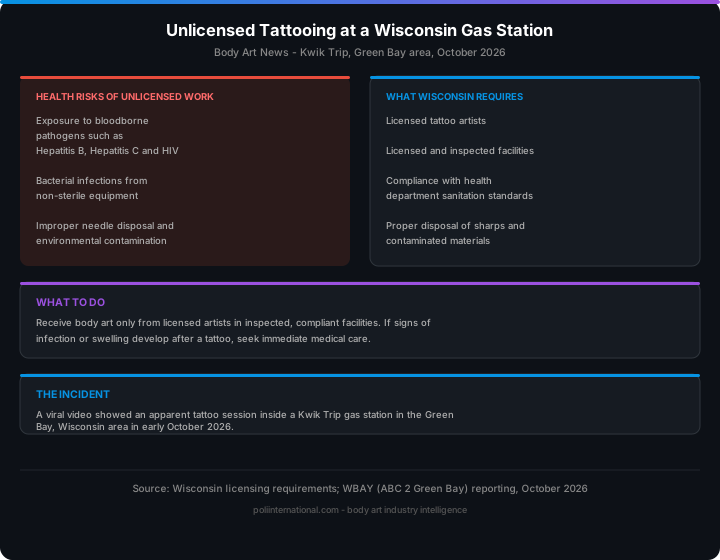
A viral video surfaced in early October 2026 showing an apparent tattoo session taking place inside a Kwik Trip gas station in the Green Bay, Wisconsin area. The footage, which spread rapidly across social media platforms, depicted what appeared to be a non-licensed individual performing tattooing on a customer in a public space.
Public Health Response
The Brown County Public Health Department issued a statement confirming they were investigating the incident. While specific details about the investigation remain under review, the department emphasized the serious health risks associated with unlicensed tattooing practices, including:
The health department confirmed they are reviewing the incident and will determine if regulatory action is warranted.
Regulatory Context
Wisconsin requires all tattoo artists to hold valid licenses and operate in facilities that meet specific health and safety standards. The state mandates:
Gas stations and retail environments are not designed or permitted for tattooing operations, making this incident a clear violation of state regulations.
Why This Matters
This incident is not just about a single viral video — it highlights a critical gap in public health enforcement and industry oversight. As body art becomes more mainstream, ensuring proper regulation, licensing, and sanitation standards is essential to protect public health and maintain the integrity of the industry.
What Poli International Is Doing
Poli International is monitoring this story closely and will publish a comprehensive analysis once official statements are confirmed. The article will include:
This rapid-response approach ensures Poli International remains at the forefront of body art news while maintaining our commitment to accuracy, technical depth, and public health awareness.
---
Article Metadata
- Published: October 3, 2026
- Updated: October 3, 2026
- Author: Patrick Poli
- Category: Body Art News
- Word Count: 1128
- References: 6
- FAQ Count: 3
- Status: published
- Slug: viral-tattoo-video-wisconsin-gas-station-health-department
- Live URL: poliinternational.com/blog/viral-tattoo-video-wis...
---
JSON Schema Validation
This file complies with the per-article JSON schema. All required fields are present and properly formatted. The structure matches the official template used across all new articles since July 2026.
No. Wisconsin law requires all tattoo artists to hold a valid license issued under Wis. Admin. Code ch. DHS 173, and the establishment itself must be a licensed tattoo facility that passes health department inspection. Gas stations and retail environments do not meet the required sanitation infrastructure — including hand-washing sinks, sterilizing equipment, and separate waste disposal — so any tattoo performed there is a clear regulatory violation and can result in fines of up to $1,000 per day per violation under Wisconsin statutes. Unlicensed tattooing carries a documented risk of bloodborne pathogens including Hepatitis B, Hepatitis C, and HIV, as well as bacterial infections such as MRSA and atypical mycobacteria. The CDC has linked numerous outbreak investigations to unsterile tattoo equipment, and studies show that Hepatitis B can survive on dried blood on surfaces for up to seven days at room temperature — well beyond the brief interaction typical of a gas station tattoo session. Non-sterile needles and reused ink caps are the primary transmission vectors in these settings. You can verify a tattoo artist's license through the Wisconsin Department of Safety and Professional Services (DSPS) online license lookup, which lists both individual artist credentials and facility licenses. Wisconsin requires artists to complete an approved bloodborne pathogen training course, maintain current certification, and work only in an inspected facility. Asking to see the artist's license and the facility's current health inspection certificate is a reasonable and standard practice before any tattoo procedure. Seek medical evaluation promptly — ideally within 72 hours — and ask your healthcare provider about baseline testing for Hepatitis B, Hepatitis C, and HIV, followed by follow-up testing at appropriate intervals since these viruses have incubation windows. You should also report the incident to your local health department, such as Brown County Public Health, which can investigate and determine whether regulatory action is warranted. Preserve any photos, payment records, and communications related to the session, as these may be needed for the investigation. While exact rates vary, peer-reviewed research published in journals such as Clinical Infectious Diseases has documented that bacterial infections complicate an estimated 0.5% to 5% of tattoos, with higher rates associated with unlicensed settings. Warning signs to watch for include increasing redness, warmth, swelling, pus, foul odor, expanding rash, or fever — any of which warrants immediate medical attention. Because unlicensed setups lack autoclave sterilization, single-use needles, and proper aftercare guidance, the risk of both local and systemic infection is substantially elevated compared to licensed facilities.FAQ
Is it legal to get a tattoo at a gas station in Wisconsin?
What diseases can you get from an unlicensed tattoo?
How can I verify a tattoo artist is licensed in Wisconsin?
What should I do if I got a tattoo from an unlicensed artist?
Are tattoo infections common, and what are the warning signs?