
Fixed premises can improve oversight; they do not automatically create safe body art
Key Takeaways:
» North Devon Council has adopted a policy requiring tattooing and cosmetic piercing businesses to operate from fixed, inspectable premises.BBC reporting
» A building is not an infection-control system; workflow, sterilization, traceability, and practitioner competence still determine safety.
» Mobile work is not inherently unsafe, but uncontrolled environments make clean-to-dirty separation and instrument processing harder to prove.
» Studios should document sterilization cycles, instrument tracking, surface disinfection, waste handling, and consent records—not merely display a registration certificate.
» Clients should judge the process, not the postcode: a fixed shop can be excellent, mediocre, or a beautifully decorated disaster.
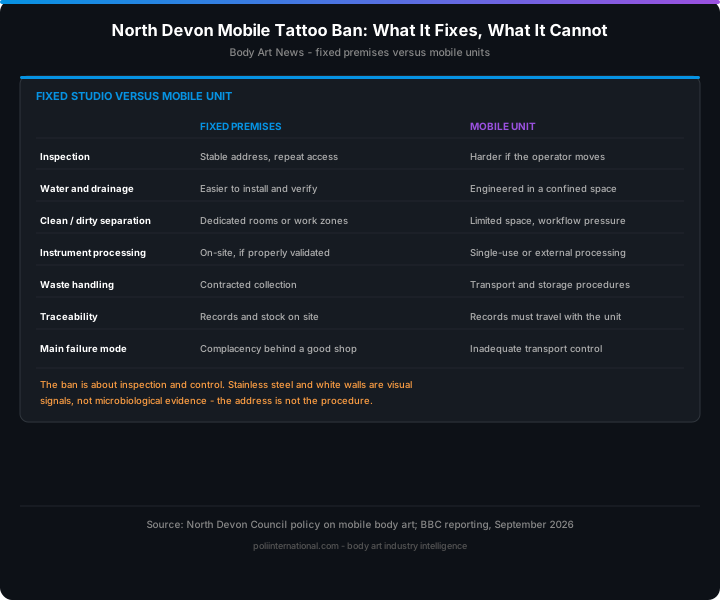
1. The Ban Is About Control, Not Magic
North Devon Council has banned mobile tattoo and piercing businesses under a new policy requiring invasive body-art services to take place in fixed premises that can be inspected and registered.BBC reporting The council cited the possibility of blood-borne viruses and other infections when appropriate safety measures are not followed.North Devon council coverage
That is the reasonable part. A fixed premises gives inspectors a stable address, a known operator, defined surfaces, controlled water access, documented waste arrangements, and somewhere to return when a business ignores a notice. Regulators like things they can find. This is not cynicism; enforcement needs an address.
The unreasonable part is pretending that fixed means safe. It does not. A registered studio can still use poor aseptic technique, mishandle sharps, overwork contaminated surfaces, or buy jewelry and consumables with no meaningful material documentation. Meanwhile, a competent mobile operator can carry a carefully designed clean kit, use sterile single-use components, and maintain excellent records. Location changes the risk profile; it does not settle the risk.
The public conversation repeatedly confuses inspectability with infection prevention. They overlap, but they are not twins. One is administrative control. The other is a sequence of physical barriers designed to stop contamination reaching tissue, blood, ink, jewelry, or instruments.
2. The Real Comparison: Fixed Studio Versus Mobile Unit
| Feature | Fixed premises | Mobile unit |
|---|---|---|
| Inspection | Stable address and repeat access for regulators | More difficult if the operator moves frequently |
| Water and drainage | Usually easier to install and verify | Must be engineered and maintained in a confined space |
| Clean/dirty separation | Dedicated rooms or work zones may be possible | Limited space increases workflow pressure |
| Instrument processing | On-site processing may be available, if properly validated | Often relies on sterile single-use supplies or external processing |
| Waste handling | Contracted collection and storage can be formalized | Transport and temporary storage require tight procedures |
| Traceability | Easier to retain records and stock | Records and stock must travel with the operator |
| Main failure mode | Complacency hidden behind a professional-looking shop | Inadequate setup, transport, or decontamination control |
The engineering question is not “Can this happen in a van?” It is “Can the operator maintain a validated chain of control from clean storage to completed procedure?” That chain includes hand hygiene, barrier placement, sterile-pack integrity, sharps disposal, surface disinfection, and the prevention of cross-contact between contaminated and unused items.
This is why sterilization rules for tattoo and piercing studios matter more than interior design. Stainless steel, white walls, and a framed certificate are visual signals. They are not microbiological evidence.
A fixed premises makes good practice easier to standardize. It also makes bad practice easier to conceal behind routine. The van gets blamed because it looks improvised. The shop gets trusted because it looks permanent. Bacteria remain unimpressed by both.
3. What the Policy Can and Cannot Prove
Tattooing and piercing breach the skin, so the relevant hazards include bacterial infection, blood-borne pathogen transmission, allergic or inflammatory reactions, and contamination of products or instruments. The council’s stated concern is therefore legitimate.BBC reporting
But the risk is controlled through validated procedures, not through the mere presence of a lease. For studios, that means separating clean and contaminated workflows; using sterile, single-use needles and cartridges where appropriate; opening sterile packages in front of the client; disposing of sharps immediately into compliant containers; and keeping reusable instruments in a documented decontamination and sterilization pathway.
Where steam sterilization is used, “the autoclave ran” is not a sufficient record. The studio needs cycle parameters appropriate to the load and device, routine monitoring, maintenance, and traceability linking packs to procedures. Chemical indicators can show exposure to a process, but they do not independently prove sterility. Biological indicators and scheduled validation provide stronger assurance because they challenge the process with resistant spores rather than merely changing colour when heated.
Surface disinfection has the same problem. A product label may claim broad efficacy, but the operator still needs the correct concentration, contact time, surface compatibility, and cleaning step. Organic material can interfere with disinfectants. Spraying a product and wiping it immediately because the next appointment is waiting is not a validated method; it is perfume with paperwork.
Mobile operators face additional engineering constraints. Water tanks can become contamination points if they are poorly maintained. Narrow work areas increase the chance that a gloved hand touches a clean item, phone, drawer, or lamp. Transport can compromise package integrity. Waste must be contained, labelled, and moved without turning the vehicle into a rolling contaminated-storage problem.
None of this proves every mobile business is unsafe. It proves that mobile work demands a system designed for mobility. A fixed shop receives regulatory credit for being stationary. It should not receive scientific credit it has not earned.
4. Patrick's Note: The Address Is Not the Procedure
The thing clients are actually worried about is simple: “If the council says mobile tattooing is unsafe, is every treatment I had outside a shop now a mistake?”
No. The relevant question is whether the work was controlled. Were sterile needles opened in front of you? Was the workstation protected and disinfected? Did the practitioner keep clean supplies away from used items? Did they dispose of the needle immediately? Could they explain what happened to reusable tools? Those answers tell you more than whether the work happened in a converted room or a converted vehicle.
I support regulators having a premises they can inspect. I do not support turning an address into a substitute for competence. A bad studio has walls. Sometimes it has excellent lighting, a logo, and a waiting room designed to make everyone feel reassured while the actual workflow is held together with optimism.
For clients, my advice is practical: watch the setup before agreeing to the procedure. For studio owners, document the controls that matter. For regulators, inspect the process rather than rewarding the floor plan. The person receiving the piercing does not benefit from a rule that makes enforcement convenient while leaving the technical questions untouched.
The same principle applies to jewelry. Material, finish, geometry, and fit affect healing and long-term comfort; they are not decorative details. The engineering difference between implant-certified titanium and generic “titanium” jewelry belongs in the conversation alongside hygiene, because safe placement followed by unsuitable hardware is still an avoidable failure.
5. FAQ: Technical Q&A
Q: Is a mobile tattoo or piercing automatically unsafe?
No. Mobile work is harder to control because space, water, waste, transport, and clean-to-dirty separation are constrained. A competent operator can manage those risks, but a fixed address makes inspection and enforcement easier.
Q: What should a client look for in any studio?
The practitioner should use a new sterile needle or cartridge, open it in front of you, prepare a clean protected workstation, and dispose of sharps immediately after use. They should also answer direct questions about jewelry materials, aftercare, sterilization, and what happens to reusable tools without becoming defensive.
Q: Does a council registration certificate prove the studio is safe?
No. It proves that the business has met the relevant registration or licensing requirement at the time of inspection. Safety depends on the controls being followed during every procedure, including when nobody from the council is watching.
Conclusion: Inspect the Process
North Devon’s policy is understandable: invasive procedures need accountable operators and premises that regulators can locate and inspect.BBC reporting But the useful lesson is not “a shop is safe and a van is dangerous.” It is that body-art safety depends on a verifiable chain of control—before, during, and after the needle touches skin.
The address is administration. The procedure is engineering. Clients and regulators should judge the latter. The real difference between sterile presentation and sterile practice is where the argument should begin.


