Shop
Market Pulse

Titanium Prices Are Not Rising Yet—That Is the Buying Window

PP

Chief Engineer

Patrick Poli

Journal Date

2026-09-30

Last Reviewed

2026-10-03

Weak Chinese Peak-Season Demand Gives Body-Jewellery Buyers Leverage Before the Next Cost Reset

Key Takeaways:

» Chinese Grade 0 titanium sponge was reported at approximately 44,000–45,000 yuan per metric tonne on 24 September, with the monthly average near 44,500 yuan.

» September demand has underperformed seasonal expectations, weakening the immediate case for a raw-material price surge.

» Stable sponge pricing does not guarantee lower finished jewellery prices because machining, certification, freight, currency, and distributor margins sit between feedstock and studio cost.

» Buyers should secure core ASTM F136 stock selectively, but avoid tying up cash in broad speculative inventory.

» Ask suppliers for fixed landed pricing, material certificates, and a 60–90-day validity period before accepting an increase.
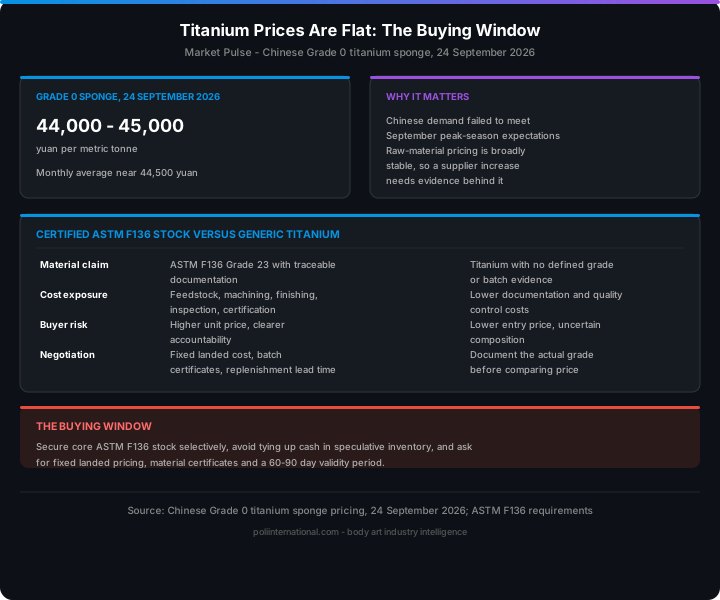
Grade 0 titanium sponge at 44,000 to 45,000 yuan per tonne on 24 September 2026 and the buyer playbook
Infographic: Grade 0 titanium sponge at 44,000 to 45,000 yuan per tonne on 24 September 2026 and the buyer playbook

1. The Market Is Softer at the Raw-Material End

The most commercially significant current signal is not a dramatic titanium rally. It is the opposite: Chinese titanium demand has reportedly failed to meet September peak-season expectations, while Grade 0 sponge titanium remained broadly stable at 44,000–45,000 yuan per metric tonne as of 24 September.September titanium industry-chain analysis

That matters because body-jewellery buyers are often presented with raw-material increases as if the quotation travels directly from a mill to a studio. It does not. A finished ASTM F136 bar or labret carries costs for forging or machining, polishing, threading, anodising, inspection, packaging, export handling, freight, foreign exchange, distributor overhead, and sometimes inventory financing. Feedstock is important, but it is not the whole invoice.

The practical implication is a temporary imbalance in negotiating power. If sponge prices are stable and seasonal industrial demand is weak, a supplier asking for an immediate blanket increase should be able to identify the actual cost driver. A vague “titanium has gone up” is not a cost explanation; it is a weather report with an invoice attached.

For buyers who have already experienced tighter wholesale terms, this is a useful moment to separate genuine cost pressure from margin repair. The wider U.S. supply market is already moving toward firmer purchasing conditions, as discussed in the analysis of how tattoo-supply consolidation is changing buyer leverage, so studios should not assume that a stable raw material automatically produces a stable wholesale market.

2. What Stable Sponge Pricing Means for Jewellery Buyers

The cost transmission chain is different for a distributor ordering certified body jewellery than for a mill selling titanium sponge. The nearer a buyer is to the finished product, the more important the supplier’s conversion and commercial policy become.

FeatureCertified ASTM F136 titanium jewelleryGeneric titanium or unverified “implant-grade” stock
Material claimASTM F136 Grade 23 titanium should be supported by traceable documentation“Titanium” may lack a defined grade or batch evidence
Primary cost exposureFeedstock, machining, finishing, inspection, certification, and stockholdingLower documentation and quality-control costs can reduce the quoted price
Buyer riskHigher unit price, but clearer quality and purchasing accountabilityLower entry price with greater uncertainty over composition and consistency
Negotiation priorityFixed landed cost, batch certificates, replenishment lead time, and rebate termsDocument the actual grade before comparing price
Commercial useSuitable for a premium, traceable jewellery programmeShould not be treated as an equivalent substitute merely because the word “titanium” appears

A buyer should therefore avoid two opposite mistakes. The first is assuming that every price increase is justified because titanium is expensive. The second is treating any cheaper titanium item as an equivalent replacement for documented ASTM F136 stock.

The correct comparison is landed cost per usable, documented unit. That calculation should include freight, duty, payment fees, defect allowance, and the cost of holding slow-moving sizes. A supplier offering a five-percent lower ex-works price may be more expensive once minimum order quantities and freight are included.

This is particularly important for smaller studios. If a studio buys 40 sizes to obtain a discount but sells only 15 regularly, the apparent unit saving is being consumed by dead inventory. In body jewellery, cash tied up in the wrong gauge or length is not a theoretical accounting issue. It is money unavailable for rent, wages, sterilisation, or the next replenishment.

3. The Technical Cost Stack Behind “Titanium Prices”

Titanium sponge is an upstream input, not finished piercing jewellery. The September market report’s figure of roughly 44,500 yuan per metric tonne describes a primary material stage, while jewellery makers work with more processed forms and incur substantially different cost structures.The September titanium price and demand assessment

For professional buyers, the relevant technical and commercial questions are:

- Is the product genuinely ASTM F136 Grade 23, rather than merely advertised as “implant grade”?
- Can the supplier provide a material certificate tied to the batch or heat?
- Is the quoted price based on finished, inspected jewellery or semi-finished components?
- Are threading tolerances, surface finish, and polishing included in the specification?
- Does the price include freight and import charges, or only the factory gate price?
- What happens if the supplier changes the alloy source during the contract period?

A stable upstream market gives buyers a reason to request better quotation discipline. Ask for separate lines for material, conversion, finishing, packaging, freight, and any surcharge. The purpose is not to force a supplier to disclose every internal margin. It is to make it possible to distinguish a real input movement from a general price reset.

The same discipline applies when comparing titanium with other jewellery materials. A lower price is not automatically a saving if the material documentation is weaker, the surface finish creates more returns, or the supplier cannot maintain consistent dimensions. The cost of one failed batch is measured in refunds, replacement stock, staff time, and lost trust—not just the purchase order.

Do not let a stable sponge price create false confidence about availability. Weak demand can cause mills and processors to reduce output, delay production, or prioritise larger industrial customers. For body-jewellery buyers, the most useful question is not simply “what is the price today?” but “what is the confirmed lead time for the exact sizes that sell?”

4. Patrick's Note: Buy the Evidence, Not the Story

The thing you are actually worried about is being charged tomorrow for a shortage that does not exist today. Ask for the grade, the batch evidence, the landed price, and the validity period. If those four things are clear, you can decide. If they are not, you are not buying titanium; you are buying a supplier’s explanation of titanium.

My commercial decision is straightforward: secure the core ASTM F136 sizes that turn every week, but do not build a speculative warehouse around a stable sponge-price headline. Put the saving into terms—fixed pricing, documented batches, and a controlled reorder window—rather than into cartons of slow-moving jewellery. The wholesale reset before the next price increase is exactly where disciplined buyers can still get ahead of the conversation.

5. FAQ: Technical Q&A

Q: Should a distributor buy extra titanium jewellery now?

Buy additional stock only where sales history supports it. Secure fast-moving gauges, lengths, and finishes for the next 60–90 days, but do not make a broad purchase solely because a supplier predicts future titanium inflation.

Q: Can a supplier justify a finished-jewellery increase if titanium sponge is stable?

Yes, but the supplier should identify the relevant cost change. Machining, labour, energy, freight, exchange rates, certification, and inventory costs can move independently of sponge pricing; a blanket increase without a cost breakdown is not enough for a professional buyer.

Q: What should studios ask for before accepting a new price list?

Request the material grade, batch documentation, finished-unit specification, minimum order, lead time, freight basis, and quotation validity. Compare the final landed cost per saleable unit, not the headline ex-works price.

Conclusion: Lock Core Stock, Keep Cash Flexible

The current titanium signal favours selective buying rather than panic buying. Chinese sponge pricing is stable, and weaker-than-expected September demand gives buyers a credible basis for challenging immediate, across-the-board increases.

For the next purchase cycle, lock the documented core sizes, negotiate a 60–90-day price window, and require suppliers to explain any surcharge by cost category. Wait on slow-moving variants until demand or lead-time data justifies the cash commitment; the commercial advantage is flexibility, not a warehouse full of metal.

Further Reading

  • The Wholesale Reset Is Coming Before the Price Increase
  • Body Art Alliance Sale Signals Consolidation Wave in Tattoo Supply Chain
  • Asia-Pacific Is Pulling Ahead: What Tattoo Studios and Distributors Should Do With the New Growth Split
  • Mind map · Titanium Prices Are Not Rising Yet—That Is the Buying Window

    • Titanium Price Buying Window
      • Weak Raw Titanium Demand

        Chinese Grade 0 titanium sponge prices remained stable at 44,000–45,000 yuan per metric tonne after September peak-season demand underperformed expectations.

        • Stable Sponge Market Prices
          • Chinese September Price Benchmark
        • Unrealized Seasonal Surge Signals
      • Finished Jewelry Cost Stack

        Stable titanium sponge pricing does not guarantee lower finished jewelry prices because machining, certification, freight, and distributor margins sit between feedstock and studio costs.

        • Conversion and Processing Expenses
          • Forging and Machining Overhead
        • Landed Cost Calculation Factors
      • Strategic Inventory Management

        Buyers should selectively secure fast-moving core ASTM F136 inventory while avoiding tying up cash in slow-moving speculative stock.

        • Core ASTM F136 Stock
          • High Turnover Sizes Selection
        • Dead Inventory Capital Risk
      • Supplier Negotiation Discipline

        Buyers should demand itemized cost justifications, fixed landed pricing, verified material certificates, and 60-to-90-day quote validity from suppliers.

        • Traceable Material Certificate Verification
          • Grade 23 Batch Documentation
        • Fixed Landed Price Quotations
    StructureProcessMaterialHazard

    4 branches, 0 sources. Each branch cites the article it came from; the labels beneath it are names, not claims.

    Titanium Quiz

    1. 1. What was the reported price range for Chinese Grade 0 titanium sponge per metric tonne as of 24 September?

      • • 30,000–31,000 yuan — This understates the actual market report figure for Grade 0 sponge, which remained higher despite weak seasonal demand.
      • ✓ 44,000–45,000 yuan — The source explicitly states that Grade 0 titanium sponge was reported at approximately 44,000–45,000 yuan per metric tonne on 24 September.
      • • 55,000–56,000 yuan — This overestimates the raw material price level, which was suppressed due to underperforming peak-season demand.
      • • 62,000–65,000 yuan — This reflects an inflated price point not supported by the raw material market analysis cited in the article.
    2. 2. Why does stable titanium sponge pricing fail to guarantee lower wholesale prices for finished body jewellery?

      • • Raw titanium sponge prices are regulated by international trade bodies that restrict wholesale discounts. — Prices are governed by commercial market factors and manufacturing overhead rather than international regulatory price caps.
      • ✓ Intermediate conversion costs such as machining, certification, freight, and distributor margins sit between feedstock and studio costs. — Feedstock is only one part of the total cost structure; added steps like forging, anodising, inspection, packaging, and logistics significantly influence final studio pricing.
      • • Finished body jewellery is manufactured exclusively from unrefined titanium ore rather than processed sponge. — Titanium jewellery requires further processed mill products derived from sponge feedstock, making conversion steps essential.
      • • Distributors are required by standards bodies to maintain fixed profit margins regardless of input costs. — Distributor pricing is determined by individual commercial strategy and market competition, not mandatory margin enforcement.
    3. 3. Which material specification represents documented, traceable implant-grade titanium suitable for core jewellery inventory?

      • ✓ ASTM F136 Grade 23 — ASTM F136 Grade 23 is the specific certified material grade identified in the source that requires traceable documentation and batch evidence.
      • • Generic Grade 0 Titanium — Grade 0 refers to an unalloyed upstream sponge material rather than a finished, certified medical-grade alloy standard.
      • • Commercial Grade 4 Titanium — Commercial pure grades lack the specific alloy composition, certification, and mechanical standards associated with ASTM F136.
      • • ISO 9001 Structural Alloy — ISO 9001 is a general quality management standard, not a material composition standard for implant-grade body jewellery.
    4. 4. What formula or comparison metric does the source recommend when evaluating quotes from different jewellery suppliers?

      • • Ex-works price per piece before freight and duties — Relying on ex-works pricing ignores crucial downstream expenses like shipping, customs fees, and defect allowances.
      • ✓ Landed cost per usable, documented unit — This calculation accounts for factory gate price plus freight, duties, defect rates, payment processing fees, and holding costs.
      • • Total weight of titanium alloy per bulk shipment carton — Weight-based metrics fail to account for finishing quality, machining complexity, certification, or saleable unit yield.
      • • Volume discount percentage divided by total minimum order quantity — Focusing solely on discount percentages overlooks the cash tied up in dead inventory from unsold sizes.
    5. 5. What financial trap occurs when a studio purchases 40 different jewellery sizes to secure a bulk discount but only sells 15 sizes regularly?

      • • The studio incurs mandatory customs fines for importing slow-moving inventory items. — Customs duties apply to entry values regardless of how fast the product sells in the studio.
      • ✓ Cash becomes tied up in dead inventory, making capital unavailable for essential operating costs like rent and wages. — Apparent unit savings from broad volume purchases are quickly eroded when capital is frozen in slow-moving gauges and lengths.
      • • The supplier automatically revokes the batch certificates for the slow-moving variants. — Batch certificates remain valid proof of material origin regardless of sales velocity.
      • • Unused titanium items suffer structural degradation within six months of studio storage. — Titanium is non-corrosive and structurally stable in storage; the issue is financial liquidity, not metal degradation.
    6. 6. What quote validity period should buyers request from suppliers before accepting a price increase on jewellery?

      • • 10–14 days — A short window forces rapid purchasing decisions without offering real protection against supplier price resets.
      • • 30 days — While standard in some industries, this duration is shorter than the strategic window recommended for securing core inventory.
      • ✓ 60–90 days — The source recommends securing fixed pricing and quote validity for 60–90 days to maintain purchasing stability.
      • • 180 days — An excessively long window is unlikely to be granted by suppliers navigating changing conversion and freight costs.
    7. 7. If a supplier demands an immediate price increase claiming raw titanium costs have risen, how should a buyer respond during a period of stable sponge pricing?

      • ✓ Request an itemised breakdown separating material, conversion, finishing, freight, and surcharges. — An itemised breakdown helps distinguish legitimate operational cost increases from opportunistic supplier margin repair.
      • • Immediately replace all certified ASTM F136 inventory with unverified generic stock. — Substituting unverified material compromises client safety and documentation traceability.
      • • Accept the blanket increase without question to avoid losing priority in production queues. — Accepting unverified blanket increases surrenders buyer leverage when raw material markets are flat.
      • • Speculatively double the order size to lock in existing prices for the next two years. — Tying up excessive cash in speculative stock creates severe liquidity risks for slow-moving sizes.
    8. 8. How did Chinese titanium demand perform in September relative to industry expectations?

      • ✓ Demand underperformed seasonal peak-season expectations, creating a softer raw-material market. — September demand failed to reach expected peak levels, keeping Grade 0 sponge prices stable and giving buyers negotiating leverage.
      • • Demand exceeded all forecasts due to rapid expansion in global studio chains. — Industrial demand was notably weaker than expected rather than experiencing a demand surge.
      • • Demand completely ceased due to environmental shut-downs across raw material processing plants. — Processing continued normally, but overall market uptake fell short of seasonal benchmarks.
      • • Demand doubled, creating immediate severe shortages across all medical titanium grades. — Market data indicated a soft, underperforming peak season rather than supply shortages.
    9. 9. According to Patrick's commentary, what four key items must be clear for a buyer to ensure they are purchasing real titanium rather than 'a supplier's explanation'?

      • ✓ Grade, batch evidence, landed price, and validity period — These four elements ensure transparency regarding material authenticity, total final cost, and price stability.
      • • Brand name, catalog size, bulk discount rate, and credit terms — Brand terms and catalog size do not verify raw material composition or landed unit cost transparency.
      • • Anodising options, polish level, packaging type, and free shipping thresholds — Surface finishes and packaging options are aesthetic and logistical features that do not validate batch authenticity or cost breakdown.
      • • Factory location, worker counts, import tariffs, and retail price suggestions — Factory operational details are internal supplier metrics rather than essential purchasing verification points.
    10. 10. Which operational expense can legitimately drive up finished jewellery prices even when titanium sponge prices remain completely flat?

      • ✓ Increases in energy, labour, machining, and freight rates — Conversion expenses like power, workforce, machining precision, and transport can fluctuate independently of raw feedstock costs.
      • • Reductions in raw material import tariffs — Reduced tariffs lower import costs rather than driving finished product prices higher.
      • • Decreased cost of quality control and certification testing — Lower certification costs reduce overhead rather than justifying a price increase.
      • • Lower warehouse storage and holding fees — Decreased inventory storage costs improve distributor margins without pushing wholesale prices upward.

    Extended Reference Table

    8 of 8 rows

    Extended reference table generated from the article and its verified research sources. Bracketed numbers jump to the matching entry in the Technical References below.

    SafetyItem, Material, or Practice Category Applicable Standard or Specification Biocompatibility & Safety Profile Clinical Application / Usage Source
    ✅ASTM F136 / ISO 5832-3 (Ti-6Al-4V ELI)Titanium AlloyASTM F136 / ASTM F136-13(2021)e1 / ISO 5832-3Highly biocompatible, extra low interstitial implant-grade alloy; essentially nickel-free (<0.05%); forms a stable, self-healing TiO₂ protective passive film; Young's modulus 110–114 GPa matching cortical bone; releases fewer metallic ions than steel, resists corrosion, and reduces biofilm formation; confirms low allergenic risk.Primary baseline standard for initial and healing body piercings (earlobe, nostril, navel, helix, tragus) across all healing stages (6 weeks to 12 months); used in surgical orthopedic and dental implants (bone screws, joint replacements).[9], [10], [11]
    ✅Titanium-Tantalum Binary Alloys (Ti-Ta)Titanium AlloyISO 10993 (Series) / FDA 510(k)Eliminates Al and V; 50–67% lower metal ion elution and 22–34% faster osteoblast adhesion compared to ASTM F136.Initial healing phases for clients with documented metal sensitivity or complex piercings.
    ✅Ti-Ta 10-15% AlloysTitanium AlloyISO 5832 (Reference)Ductility: 14–16% elongation; prevents micro-fracture seeding in high-stress joints; higher safety margin against mechanical failure.Threaded posts and seamless rings requiring flexibility during initial healing and daily wear.
    ✅Unalloyed Titanium / Commercially Pure TitaniumTitanium AlloyASTM F67 / ISO 5832-2Commercially pure titanium with documented biocompatibility; lightweight, highly biocompatible, and does not release nickel; safe choice for individuals with nickel sensitivity.Safe implant-grade metal for initial body piercing jewelry and healing piercings.[9], [10]
    ✅ASTM F1295 / ISO 5832-11 (Ti-6Al-7Nb ELI)Titanium AlloyASTM F1295 / ISO 5832-11Extra low interstitial implant-grade biocompatible titanium alloy for medical and body jewelry implants.Initial and healing implant-grade body piercing jewelry.[9]
    ✅Cobalt-Chrome (CoCrMo)Cobalt AlloyASTM F1537 / ASTM F75 / ASTM F799Fatigue life ~4x greater than titanium; high hardness/stiffness; higher allergy risk if Co and Cr ions are released; high MRI artifacts.Long-term structural needs, load-bearing joint replacements, and high-stress surface bars (not ideal for direct osseointegration studs).
    ✅ASTM F138 / ISO 5832-1 (316L / 316LVM Stainless Steel)Stainless SteelASTM F138 / ISO 5832-1 / ISO 10993-6 / ISO 10993-10 / ISO 10993-11Proven biocompatible steel grade for implants; contains Cr₂O₃ passive layer and 13.0–15.0% nickel content with risk of leaching (up to 14%); must withstand autoclave sterilization and be non-irritating.Initial body piercings (rings, bars, studs) and long-term wear in fully matured piercings.[9]
    ⚠️AISI 304 SteelStainless SteelAISI 304Industrial grade steel; not implant-grade and unsuitable for healing puncture wounds.Commonly used in general industry; contraindicated for initial body piercings.

    Free Body Art Wall Posters

    Print-ready reference posters for your studio or your own wall. Free to download and display, embed on your own site with attribution. Click any poster to preview it full size before downloading.

    Choose and download all 40 posters

    Technical_References_Archive

    About the Author

    PP

    Patrick Poli

    Chief Engineer, Poli International · Creator of BioFlex® body jewelry

    Patrick has spent 25+ years manufacturing body jewellery and studio equipment, and is the creator of BioFlex® body jewelry. He founded Poli International with his son Frédéric to work on recyclable and bio-friendly materials for tattoo and piercing. He also made custom titanium body jewellery in metric sizes the market still does not offer, because manufacturers stop at 2 mm steps and a piercing rarely fits a round number.

    More about Patrick →

    Last reviewed: 2026-10-03 · Published: 2026-09-30

    Continue Reading